

Why the Timing is Bad to Start the 3-2-1 Lottery
On the proposed 3-2-1 lottery and why the 2027 Draft is an inopportune time to start this change.

The NBA is set to vote on a lottery reform proposal called the “3-2-1 lottery.” It would be a radical change that fundamentally alters how the league allocates top draft picks.
The proposal would include:
Expanding the lottery to 16 teams
Switching from multiple ping-pong ball combinations to drawing a single ball to determine each selection
Drawing all 16 lottery selections instead of only four
Flattened odds where teams in the 4-10 range get three lottery balls, or 8.1 percent odds
A “relegation zone” where the bottom three teams and 9-10 seeds get two lottery balls, or 5.4 percent odds
One lottery ball for each loser of the 7-8 Play-In Tournament games, or 2.7 percent odds
No consecutive No. 1 pick winners and no three-year consecutive top-five picks
No protections on picks from 12-15
Expanded disciplinary anti-tanking measures, including the option to reduce lottery odds and draft position
Implementation starting with the 2027 draft through the 2029 draft, followed by a league reevaluation to decide whether to continue with it or switch to a different system
In theory, this should reduce tanking at the lowest levels of the league. Some teams will still want the highest odds and could look to get out of the relegation zone and Play-In Tournament range to gain a third lottery ball. But the difference in odds is immaterial. This is effectively flat odds across the board compared to the current system.
This would not eliminate all incentives for teams to lose games across every competitive tier. The system could incentivize teams in the Play-In Tournament range to lose the 7-8 game and gain a lottery ball. But competitive playoff seed jockeying already exists. We often see teams position themselves for a particular side of the playoff bracket. The league is essentially agreeing to allow a little more tanking at competitive levels in exchange for better March and April games across the league.
There has been an outcry of valid concerns about flatter lottery odds across the NBA mediaspace since January, when some of these ideas were soft-launched. The 3-2-1 lottery not only feels like the culmination of those ideas, but a rushed solution that looks like an overreaction to the league’s biggest tanking season. For what it’s worth, the current lottery system, which was a reaction to the Process Sixers, took multiple years and rounds of votes to eventually get implemented.
The NBA is dead set on implementing lottery reform. We can all agree that tanking at the lowest levels is bad for the sport. Having a third of the league not trying in the second half of the season will cause reputational damage and tune out fans over time.
But the worst thing the league can do is be reactionary and speedrun a completely new system, especially during the current Collective Bargaining Agreement (CBA). The implementation of the second apron and its restrictions puts a stronger emphasis on roster building through the draft. This new lottery system would throw a wrench into multiple years of planning for many teams.
There will be significantly less tanking among lottery teams in 2026-27, but it will have almost nothing to do with flatter odds. It will largely be because so many 2027 first-round picks are already encumbered through trades and swaps.
Over the past decade, teams have traded multiple first-round picks more often than ever. The Stepien rule prohibits teams from trading future first-round picks in consecutive drafts. So they traded multiple picks every other year in the same deal in aggressive “all-in” moves. The majority of these teams sent out selections in odd-numbered years, especially 2025 and 2027. The result is an uneven distribution of traded future first-round picks that is heavily skewed toward odd-numbered drafts.
In December 2024, Third Apron analyzed this trend. At the time, 10 teams had already traded an unprotected 2027 first-round pick.
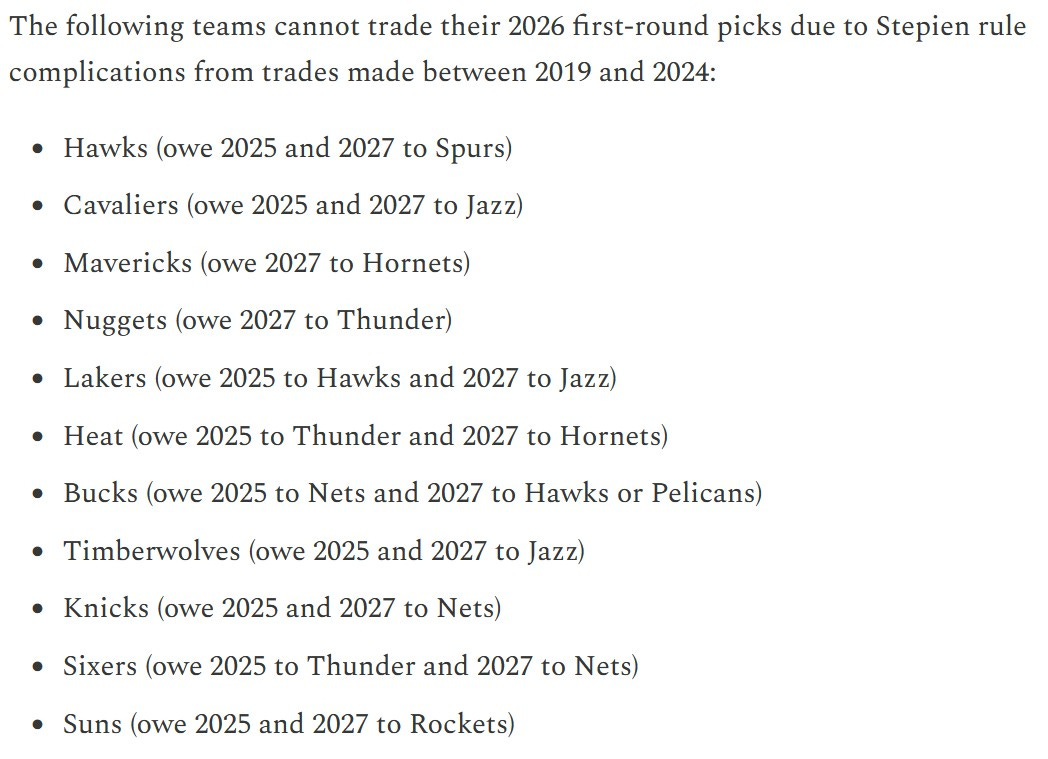
By virtue of the Stepien rule, these teams were unable to trade their 2026 first-round picks. A total of 13 first-round picks in the 2025 draft were traded ahead of the 2025 trade deadline, with five encumbered through swaps. In comparison, eight first-round picks in the 2026 draft have been traded ahead of the 2026 trade deadline, with five encumbered through swaps.
As of today, 11 first-round picks in 2027 are set to change hands:
Bucks: owned by the Pelicans or Hawks
Pelicans first-round pick is encumbered, but they’ll keep the lesser of their own and the Bucks pick. So they may just keep their own and reroute the Bucks’ pick to the Hawks
Mavericks: owned by the Hornets, top-two protected
Suns: owned by the Rockets
Heat: owned by the Hornets, lottery protected
Hawks: owned by the Spurs
Timberwolves: owned by the Jazz, Grizzlies, or Suns
Cavaliers: owned by the Jazz, Grizzlies, or Suns
Jazz first-round pick is encumbered, but they’ll keep the second most favorable of their own, Timberwolves, and Cavaliers. So just 2 of the 3 can go out
Lakers: owned by the Grizzlies
Knicks: owned by the Nets
Nuggets: owned by the Thunder
Spurs: owned by the Thunder
There are also two significant swaps in play:
Nets: owned by the Rockets
Clippers: owned by the Thunder
The following teams cannot trade their 2027 first-round picks due to Stepien rule complications:
Magic: outgoing 2028 first-round pick
Clippers: outgoing 2028 first-round pick to the Sixers
The Sixers also traded their 2028 first-round pick to the Nets, but they could trade their 2027 first-round pick since they have the Clippers’ unprotected 2028 first-round pick
The following teams still have control over their 2027 first-round pick:
Celtics
Hornets
Bulls
Warriors
Grizzlies
Sixers
Trail Blazers
Kings
Raptors
Wizards
This phenomenon is important to keep in mind when projecting the potential order of the 2027 draft. CapSheets is the only NBA salary cap resource that includes future first-round pick estimates for the following draft and projections for where they may land. The 2027-28 sheets are not up yet, but they will have these projections and will be updated often as the season progresses.
We still have a whole transaction cycle to go before we get an idea of what it will look like. But if this season is any indication of what the top 16 could look like, it might look something like this:
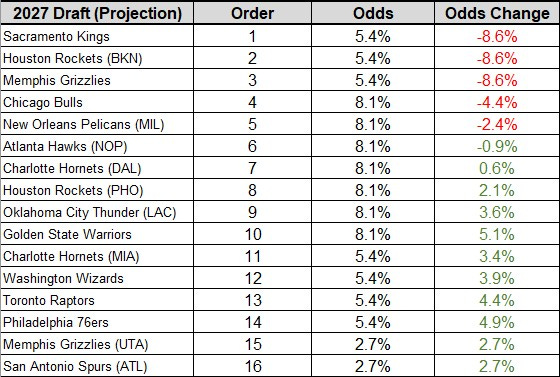
In this projection, multiple valuable lottery picks are exchanging hands due to miscalculated trades by teams that thought they would be in contention by 2027. It includes seven lottery picks outright, as well as swaps between the Nets and Rockets and the Clippers and Thunder, which could result in two more playoff teams receiving lottery picks.
Adding two additional teams to the lottery already increases the likelihood of more outgoing first-round picks becoming lottery picks. But the 2027 draft already has an abnormally high number of outgoing first-round picks. In comparison, the 2025 and 2026 drafts only saw two lottery picks traded ahead of the preceding trade deadline end up in the lottery.
The 2026 tanking crisis was the perfect storm of:
A perceived strong upcoming draft class at the top
A large portion of the league unable to trade its 2026 first-round picks
Teams like the Jazz and Wizards bottoming out to keep their top-eight protected picks
The 2027 draft is considered one of the weaker ones in recent memory, and so many of its selections have already been traded. In all likelihood, we will not see a race to the bottom close to what we saw this season since many of the incentives to lose games next season are already eliminated.
This is especially pertinent to potential lottery teams like the Nets, Mavericks, Clippers, Bucks, Suns, and Jazz. They are already incentivized to win and avoid conveying a valuable pick under the current system. If the odds are generally the same, what difference does it make for them to finish bottom three versus 4-10? Why exhaust their players in too many meaningless end-of-season games to avoid the relegation zone when it will not materially impact them?
This dovetails into another important question: who stands to benefit the most over the next three years?
It might not help bad teams like the Kings, Pelicans, Bulls, and Bucks that are earnestly trying to win games but are genuinely bad. We are almost certainly going to see a bottom-tier team in the relegation zone suffer the worst-case scenario of getting a selection in the 10-12 range.
The teams this likely will help are those that already have a significant surplus of first-round picks between the 2027 and 2029 drafts. Teams like the Nets, Hornets, Rockets, and Grizzlies now have a lot more variance with multiple first-round picks in 2027 and a higher chance of getting a top pick if the teams that owe them picks miss the playoffs. It also opens the door for the league’s worst-case scenario: the Thunder or Spurs getting a much higher 2027 draft pick through their swaps with the Clippers or Hawks, respectively.
The NBA could implement these changes and take a victory lap, declaring it curbed tanking, when in reality, forces beyond its control were always going to curb tanking next season.
Or, the NBA could wait another year to come up with a lottery system that better identifies which teams are actually the worst in the league and need help the most. The 3-2-1 system does not help the true bottom-dwellers.
The league can afford to wait a year since the 2026-27 season will not have a tanking crisis like 2025-26. Teams should also get more time to transition to these changes. The new CBA rolled out several changes 1-2 years after it came into effect. It only makes sense to give teams more time to reconfigure their long-term outlook instead of altering multiple years of planning overnight.
The NBA needs to keep these factors in mind and be careful before rushing into a league-altering decision. Otherwise, there is a chance that all this will accomplish is disproportionately enriching teams that did not need the help, while leaving some bottom-dwellers at the bottom for longer.
2026 Offseason Previews

Atlanta Hawks | Boston Celtics | Brooklyn Nets | Charlotte Hornets | Chicago Bulls | Cleveland Cavaliers | Dallas Mavericks | Denver Nuggets | Detroit Pistons | Golden State Warriors | Houston Rockets | Indiana Pacers | Los Angeles Clippers | Los Angeles Lakers | Memphis Grizzlies |
2026 Contract Projections
Current Extension Eligible Players Part 1 | Current Extension Eligible Players Part 2 | Current Extension Eligible Players Part 3 | Current Extension Eligible Players Part 4 | Standout Minimum Players | Free Agents and Pending Options Part 1 | Free Agents and Pending Options Part 2
You can also see my work on:
You make some very good points, and I agree the NBA should not rush the process. Draft reform is needed, but the league needs to take its time and do it right.
One thing I think it's important to clarify, because a lot of people don't really understand it, is that the Stepien Rule doesn't prohibit teams from trading away any or all of their own draft picks, as long as they have someone's first round pick in alternate years. (For example, the Nets own the Knicks picks in 2027, 2029 and 2031. So if the Nets wanted to, they could offer the Bucks their own 6 picks in a row from 2027-2032 <two of which are subject to swaps>, in a trade for Giannis, and the Nets would end up with the 3 Knicks picks and Giannis.)
The reason this is important goes to your point that most teams have already traded their picks and therefore do not have an incentive to tank. If the remaining teams traded their picks as well then the tanking problem would be solved.
The league should encourage teams to trade their picks to each other. A simple rule would do it. Something like: If a team owns its own first round pick at any time during the season, and that pick ends up in the lottery, it will go to the end of the lottery.
I think if that rule was in place, any of the teams that still had their own picks the day before the season started would find a way to trade them with each other.