

The Knicks Primer on Trading for Giannis
As we get closer to a resolution on the Giannis situation, it's time to take a serious look at the Knicks as a viable option for him and the difference between trading for him now or in the offseason

It’s been nearly nine months since ESPN’s initial report about Giannis Antetokounmpo’s openness to playing elsewhere. No trade request was made, so the Bucks made an unprecedented salary cap maneuver in an attempt to remain competitive with him. They certainly did right by him, but their moves have been unsuccessful.
The Bucks are currently out of the Play-In picture and headed for the lottery. Antetokounmpo is clearly out on this team both mentally and physically after ruling himself out for the next 4-6 weeks. Through all this, we’ve been subjected to trade speculation and the flirtation of a trade request where neither he nor the Bucks has been motivated to push for a move, but are clearly headed for a separation.
This drawn-out process will soon lead to action. We are now approaching a point where something is going to have to give, whether it’s at the February 5 trade deadline or in the offseason. It seems like we’re barreling toward an outcome where the Bucks have no choice but to trade Antetokounmpo after he presumably declines their contract extension offer in the 2026 offseason. They otherwise risk losing him to teams positioning themselves for him in 2027 free agency, like the Heat, Nets, Lakers, and Clippers.
Then there are the Knicks, the one team we definitely know Antetokounmpo has interest in. They won’t be able to create the cap space necessary without decimating their core. They’d need to trade for him between now and the 2027 trade deadline. While the recently struggling Knicks would be happy to get him now or later, the timing of such a trade has major roster-building implications for them.
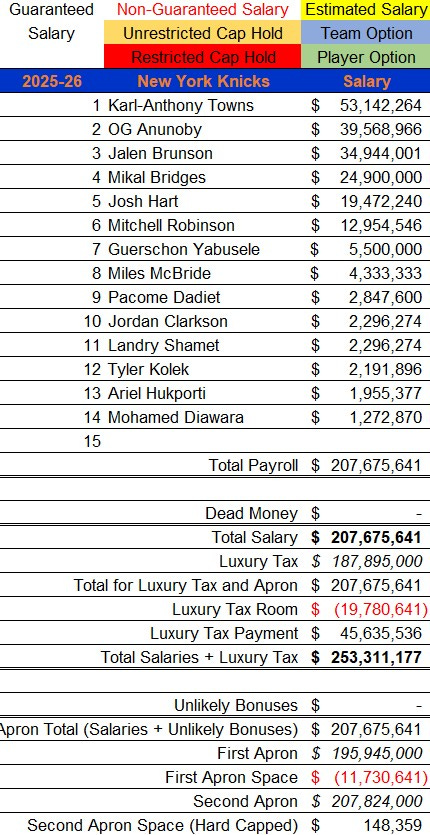
The Knicks are currently above the $195.9 million first apron and just $148,359 below the $207.8 million second apron. They cannot exceed the second apron since they used the $5.7 million taxpayer mid-level exception to sign Guerschon Yabusele. As a team above the first apron, they cannot take back more salaries than they’re sending out.
To acquire Antetokounmpo, the Knicks must send out at least 100 percent of his $54.1 million salary. They could make it work with Karl-Anthony Towns ($53.1 million) and another small salary. They could also trade multiple starters instead of Towns to make the salary-matching component work.
On the surface, the Knicks don’t seem like a viable suitor. They can’t trade any first-round picks since they owe the Nets unprotected first-round picks in 2027, 2029, and 2031. The Stepien rule prevents teams from trading picks in consecutive years. This prevents them from trading any of their first-round picks in 2026, 2028, 2030, and 2032. However, they can trade swapping rights of those selections.
Two years ago, the Knicks had up to eight tradeable first-round picks. They traded five of them, four of which were their own in odd-numbered years, for Mikal Bridges. They traded another one to acquire Karl-Anthony Towns, used another to select Pacome Dadiet, and traded the other for five second-round picks.
Perhaps they would’ve used them to acquire Antetokounmpo then, if he had been available, but they understandably couldn’t wait to find out. Teams can’t always choose the exact stars they want, so the Knicks acquired who they could get. And now that he is available, the Knicks would not only have the challenge of constructing a package for him, but also reorganizing their cap sheet around him.
