

Maximizing the Bulls Cap Space - 2026 Offseason Preview
On the Chicago Bulls' outlook with a new front office, who is in their long-term plans, and how they could maximize their cap space to accumulate more assets.

Six years ago, the Bulls moved on from their previous regime after more than a decade. They needed new leadership that could elevate them from a mediocre team at best into a sustainable playoff team. The vision seemed promising at first after several moves made them look like a serious threat in the East at the beginning of the 2021-22 season.
That vision turned out to be short-lived. They continued to miss the playoffs afterward and failed to recognize when the roster construction had stopped working. Instead, they held onto their top players for too long and received poor value in return, including zero first-round picks. It often felt like the plan was less about adjusting course and more about trying to force the original one to work.
The Bulls are now resetting their leadership again, and hopefully, things will actually be different this time. They need to be patient so they can build a cohesive group that could contend for a long time. They also need to use their flexibility to accumulate assets over veterans, at least in the short term. Otherwise, they risk extending their playoff drought and remaining stuck in a perpetual, unintentional rebuild.
2026 Offseason Previews

Atlanta Hawks | Boston Celtics | Brooklyn Nets | Charlotte Hornets | Chicago Bulls | Cleveland Cavaliers | Dallas Mavericks | Denver Nuggets | Detroit Pistons | Golden State Warriors | Houston Rockets | Indiana Pacers | Los Angeles Clippers | Los Angeles Lakers
2026 Contract Projections
Current Extension Eligible Players Part 1 | Current Extension Eligible Players Part 2 | Current Extension Eligible Players Part 3 | Current Extension Eligible Players Part 4 | Standout Minimum Players | Free Agents and Pending Options Part 1 | Free Agents and Pending Options Part 2
Salary cap situation and draft picks
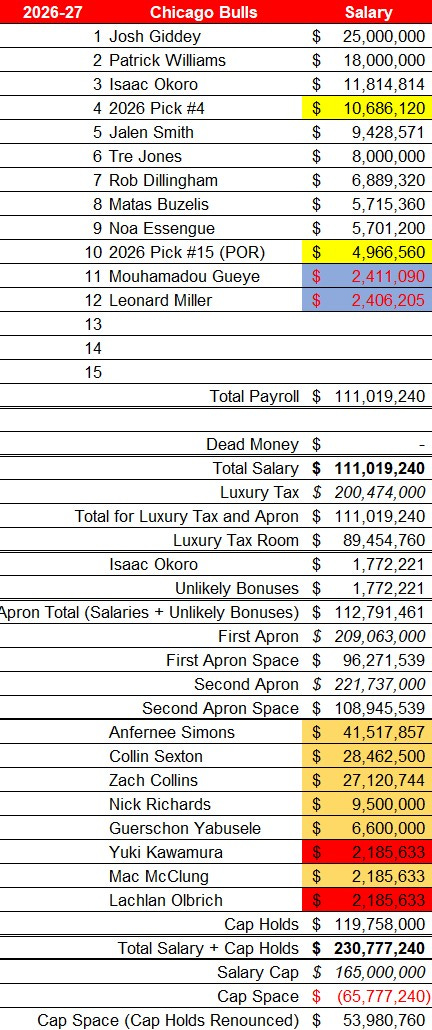
The Bulls are entering the offseason with 12 players under contract totaling $111 million in salary, including their two first-round picks. They are well below the luxury tax and aprons, as well as the $165 million salary cap. They are positioned to operate with significant cap space and can create a maximum of $54 million.
To access that cap space, the Bulls need to make a couple of procedural moves. The first is renouncing the cap holds of their top free agents, including Anfernee Simons, Collin Sexton, and Zach Collins. They would lose their Bird rights, but that is only useful when operating over the cap. They could still re-sign and even extend those players before June 30, but doing so would eat into their cap space.
It is also worth noting that the Bulls have several large trade exceptions, including one worth $18 million. Teams cannot have cap space and trade exceptions at the same time, so they would have to renounce those as well to officially access cap space. They could still use them during the current salary-cap year, but any salary they take on would reduce the amount of cap space available next month.
The Bulls would have $54 million in cap space after renouncing all free agent cap holds. They could get to $56 million if they decline the minimum-salary team options for Leonard Miller and Mouhamadou Gueye. However, both salaries remain guaranteed through the January 7 guarantee date if their options are picked up. They will probably pick them up since they could still waive them later, which means they are likely working with roughly $54 million in cap space.
That is currently projected to be the most cap space of any team this offseason. It is more than the competitive Lakers ($48 million) and the rebuilding Nets ($40 million). The Bulls should be in a strong position to take on bad salaries with young players or draft picks attached. They will, however, face competition for those deals from teams like the Grizzlies and Mavericks, which have large trade exceptions to facilitate them.
The Bulls will have plenty of options with that cap space. They can absorb just about any player in a trade. They could also sign any player to a maximum-salary contract starting at $41.25 million for players with 0-6 years of service. They will probably use that flexibility to add veterans who fit their timeline while also taking on bad salaries with draft compensation attached.
