

The Ultimate Guide to the Lakers Cap Space - 2026 Offseason Preview
On the Lakers offseason, cap space scenarios, restricted free agency, trade possibilities, contract projections for own free agents, room mid-level exception, and more.

The Lakers just finished year two with Luka Doncic and have plenty of progress to report. They won more games than last season and advanced to the second round of the playoffs. J.J. Redick has established himself as a strong floor-raising coach after two straight 50-win seasons and some growth in the postseason. Austin Reaves has elevated himself to an All-Star caliber player with significant strides on offense.
After that, there is much work to be done on the roster if the Lakers are going to become legitimate title contenders. They acquired Doncic with a roster not best suited for him. They are now entering a pivotal offseason with the opportunity to reshape the roster with more compatible pieces and much-needed defensive personnel by using cap space.
It’s still unclear exactly how much cap space the Lakers will have and if it will even result in the roster changes they want. But there are more uses for it beyond traditional free agent signings. This guide will explain how their cap space will be calculated, how free agents like Reaves and LeBron James factor into it, how they can use it to add to the roster, and what else they can do after spending it.
2026 Offseason Previews

Atlanta Hawks | Boston Celtics | Brooklyn Nets | Charlotte Hornets | Chicago Bulls | Cleveland Cavaliers | Dallas Mavericks | Denver Nuggets | Detroit Pistons | Golden State Warriors | Houston Rockets | Indiana Pacers | Los Angeles Clippers | Los Angeles Lakers | Memphis Grizzlies |
2026 Contract Projections
Current Extension Eligible Players Part 1 | Current Extension Eligible Players Part 2 | Current Extension Eligible Players Part 3 | Current Extension Eligible Players Part 4 | Standout Minimum Players | Free Agents and Pending Options Part 1 | Free Agents and Pending Options Part 2
Cap space projections and how Austin Reaves factors in
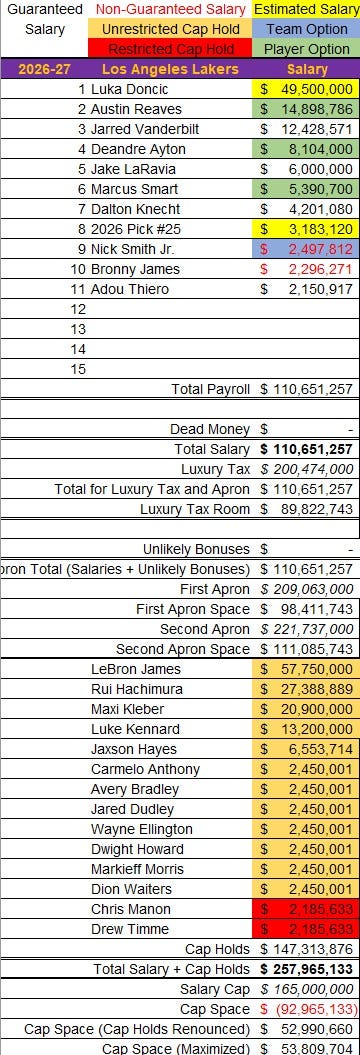
The Lakers are entering the 2026 offseason with 11 players tentatively on the roster, but that’s before factoring in pending option decisions. They have several players with player options, most notably Austin Reaves. He’s expected to decline his $14.9 million player option and is the upcoming free agent in the league most likely to.
That would leave the Lakers’ total payroll at a maximum of $95.7 million. Their proximity to the salary cap would have them operate as a cap-space team for the first time since 2019. They would be able to use cap space to sign free agents up to their respective maximum salaries, make imbalanced trades for expensive players under contract, and claim waived players. They would also have access to the $9.3 million room mid-level exception afterward to sign a player for up to three years, $29.5 million.
Although the Lakers’ payroll is roughly $70 million below the $165 million salary cap, they don’t actually have that amount in cap space yet. They would need to renounce free agent cap holds to realize that space. Cap holds are placeholders that artificially keep teams above the salary cap. Teams typically don’t renounce them if remaining over the cap preserves more useful flexibility than creating cap space.
More importantly, cap holds represent a player’s Bird rights to his team. Teams can re-sign a player up to the limits of his respective Bird rights as long as they don’t renounce them. To access cap space, the Lakers would need to renounce the Bird rights to several of their highest-paid free agents, including LeBron James, Rui Hachimura, Maxi Kleber, and Luke Kennard. They would also renounce the rights to all free agents who haven’t been on the team for years, like Carmelo Anthony and Dwight Howard.
The Lakers’ total cap space projection is very fluid and likely won’t be determined until the week before free agency starts. As shown on the cap sheet, they could create around $53 million in cap space if they renounce all cap holds, and even more if they decline Nick Smith Jr.’s team option and waive Bronny James. They’re likely to operate with closer to $48 million because they’ll keep Reaves’ cap hold on the books.
Reaves will be a free agent with full Bird rights upon declining his player option. The cap hold for players with Bird rights is calculated as either 150 percent of their previous salary if it was greater than the estimated average salary, or 190 percent of their previous salary if it was less than the estimated average salary. That determination was made last offseason, when the estimated average salary for the 2025-26 season was set at $13.87 million.
Reaves will have a $20.9 million cap hold, which is 150 percent of his $13.9 million salary, because it was slightly higher than the $13.87 million estimated average salary. That narrow margin makes a significant difference in the Lakers’ cap space projection. They’ll have nearly $6 million more cap space with his $20.9 million cap hold than they would have had with a $26.4 million cap hold under the 190 percent multiplier.
