

Understanding the LaMelo Ball Trade
On the LaMelo Ball trade, salary cap mechanics, forward options for the Wolves, the Anthony Edwards supermax factor, why the Hornets did it, and how this opens room for a Brandon Miller extension.

Last night, we received a surprising bit of news that the Hornets are listening to offers for LaMelo Ball. This comes off a career-best season in which he fueled the Hornets to a 50-win pace in the second half of the season. It seemed like they finally established their core and were set to build off it. According to Marc Stein, the Timberwolves and Raptors were the two frontrunners to acquire him.
This morning, Ball was traded to the Wolves along with Josh Green. In return, the Hornets will receive a package featuring Naz Reid and an unprotected 2033 first-round pick. They’ll also receive first-round pick swaps in 2028, 2029, and 2030, as well as second-round picks in 2029, 3032, and 2033. They are completely out of draft equity to trade other than a 2030 second-round pick from the Grizzlies that is unlikely to convey (31-55 protected).
Earlier this week, the Wolves agreed to trade Julius Randle and the 28th pick in the draft (Joshua Jefferson) to the Nets for the 33rd pick in the draft (Isaiah Evans). The move cleared $66 million of their books and created a $33 million trade exception. It was unclear if this move was the prelude to something bigger or simply a move to get them under the luxury tax line. At a minimum, they were going to add more depth with that trade exception or the $15 million mid-level exception.
This trade, which can’t be official until July 6 since the Bulls required cap space to acquire Nic Claxton, will be expanded to include the Wolves’ acquisition of Ball for several reasons. The first is that Reid’s $23.3 million salary isn’t enough to match Ball’s $41.25 million individually. Randle’s $33.3 million salary is ($9,098,000 trade exception). Then they could simply trade Reid for Green and create a trade exception worth the difference in their salaries.
However, the Wolves can no longer function as a below-apron team. Ball’s $41.25 million salary is too high for them to field a roster below the first apron while factoring in Ayo Dosunmu’s new five-year, $112 million contract. It is expected to start at $19.3 million, the lowest it could be with standard raises. They now must operate as an above-apron team so they can fill the rest of the roster, meaning they must do a 100 percent salary match.
The trade is simple:
Ball ($40.8 million + $479,480 from trade bonus) + Green ($14.7 million) = $56 million
Randle ($33.3 million) + Reid ($23.3 million) = $56.6 million outgoing salaries. So this works from the Wolves’ perspective.
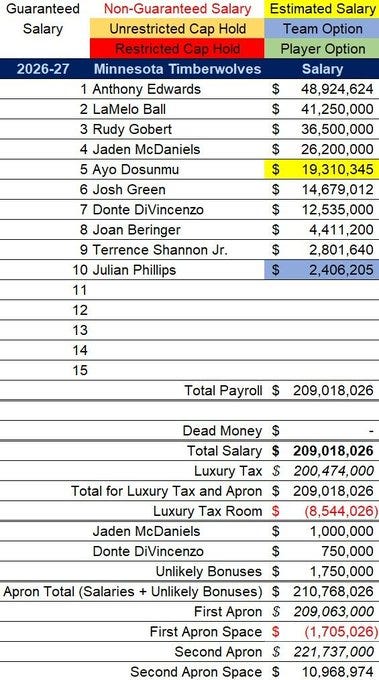
The Wolves are now hard capped to the $221.7 million second apron as a result of aggregating multiple salaries while taking back fewer salaries than they’re sending out. They project with $11 million in room below the hard cap to fill up at least four roster spots. They effectively have $9.6 million to spend on three if one of those spots goes to Evans on a rookie minimum salary ($1.35 million).
The once supersized Wolves are now looking very thin in the frontline. They will have a difficult time finding an upgrade with no draft picks left to trade. They might need to part with one of Terrence Shannon Jr. or Joan Beringer to get a team interested. Otherwise, they’re looking at starting a lineup featuring LaMelo Ball, Ayo Dosunmu, Anthony Edwards, Jaden McDaniels, and Rudy Gobert.
The Wolves would have limited options for upgrading the frontcourt. They will no longer create a $33 million trade exception and lose access to all trade exceptions created last season, including the $10.8 million one. They also lose the $5.5 million bi-annual exception and get the reduced $6 million taxpayer mid-level exception instead of the $15.5 million one. They are highly unlikely to get a starter with that amount.
Their best path to acquiring a new starting-level forward is through trade. Green’s $14.7 million and Donte DiVincenzo’s $12.5 million salaries can be traded for players earning up to those amounts or less. If the Wolves acquire Green, they would be unable to aggregate his salary for a more expensive player. This means their options could be limited to players like Naji Marshall, Jalen Smith, Royce O’Neale, Obi Toppin, Dorian Finney-Smith, and Grant Williams, who would’ve made sense for the Wolves to be included in the deal.
They could get a more expensive forward if they expand the trade further. That would mean the Hornets reroute Green to another team, while the Wolves include DiVincenzo. This would put them in play to acquire more expensive options like P.J. Washington, Keldon Johnson, Kyle Kuzma, Santi Aldama, and Cameron Johnson. Miles Bridges also would be a nice addition, but the Hornets held onto him as well.
Most of the swaps traded to the Hornets aren’t likely to convey. The Wolves already owe their top-5 protected 2029 first-round pick to the Jazz. The only way the Hornets get it is if the Wolves miss the playoffs in 2029. The Hornets would then have a solid chance of that selection moving up after lottery reform flattened odds and increased the number of teams to 16.
Meanwhile, the Wolves already swapped out their 2030 first-round pick a couple of years ago. They will receive the lesser of their own, the Mavericks, or the Spurs first-round pick that year. The swap can only convey to the Hornets if the Wolves are worse than all teams involved and the Spurs get to make a swap first.
Most of the second-round picks should convey to the Hornets. The only one that might not is the 2029 second-round pick, which would go to Utah if the Wolves’ 2029 first-round pick falls in the top-5 protection range. But that would be a good thing since it means the Hornets are getting a top-5 pick.
This trade continues a trend of the Wolves’ going all-in with their draft equity as soon as it becomes available to them. They traded all their first-round picks for Rudy Gobert in 2022. They traded their 2031 first-round pick as soon as it became available to trade in 2024 for Rob Dillingham. And now they do the same with their 2033 first-round pick for Ball.
This time, it feels like there’s an added layer of desperation. Not only do they trade their first-round pick, but also Reid. It may not seem like a great return for Ball, but it’s a lot for the Wolves to give up. It’s a risky move that, if it backfired, could shut the competitive window for this team.
But if there’s a reason the Wolves are taking this risk now, look no further than Anthony Edwards. He will be extension-eligible this season for a two-year deal, but he is unlikely to accept it. That’s because he will become eligible for a four-year, $300 million supermax extension next offseason if he makes an All-NBA team. He would’ve qualified for it, had he qualified for the 65-game rule this past season.
There is already starting to be a lot of noise about Edwards’ future in Minnesota. They built a good team that should make the playoffs and win a series or two, but their lack of trade flexibility seems to cap them there. Now they have a chance to increase their ceiling with Ball, and if Edwards can make another leap to being an MVP candidate. Either way, this move was partly a Hail Mary to show Edwards they are still serious about maximizing their window around him in hopes of securing a supermax extension next summer.
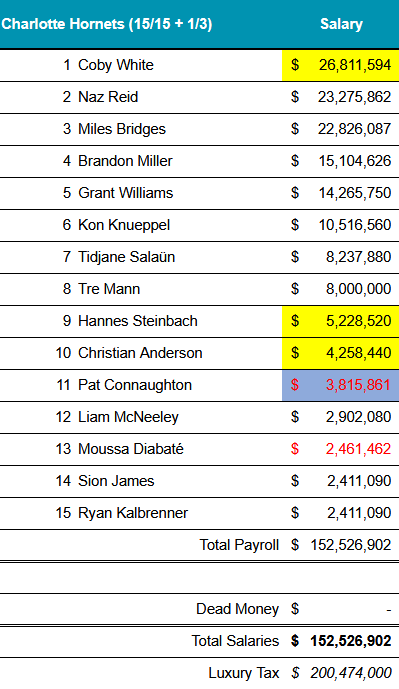
The Hornets will reduce their payroll by $30 million with this trade. They’re able to take back so few salaries because the multi-team framework has the Nets and Bulls taking back significantly more salaries. After re-signing Coby White to a three-year, $74 million contract, they have roughly $50 million in space below the luxury tax line. They won’t exceed that threshold this season.
The Hornets are now below the $165 million salary cap, but they’ll operate as an over-the-cap team. They’ll have more spending power that way since they could re-sign White with his Bird rights, and use the $15 million non-taxpayer mid-level exception on a free agent or as a trade exception. They could also take on more salaries in a trade or sign-and-trade.
They are also set to create a $40.8 million trade exception in this trade, which would be the biggest in NBA history. The trade will be structured as follows:
Josh Green ($14.7 million) for Naz Reid ($23.3 million). They can use the $9,098,000 expanded trade exception to take back up to $23.8 million for Green.
This means they’re trading Ball’s $40.8 million salary for nothing, thus creating the big trade exception. The Hornets still have enough space to use it and most of the mid-level exception while remaining under the tax line. Using the expanded trade exception will hard cap them to the first apron, but that’s okay since they won’t exceed the tax anyways.
So why would the Hornets do this? They wouldn’t have gone as far as they did last season without Ball having a borderline All-NBA caliber season. They are seemingly taking a step back by trading their All-Star and the best player in the trade.
The Hornets appear to be getting ahead of a couple of things. The first is the potential of a regression or, at least, another injury-riddled season. Ball only played in 57 percent of potential games in the previous three seasons. This was likely the best chance for them to maximize value for him, and they capitalized.
They also just didn’t want to be in the Ball business anymore. He is entering the third year of a five-year maximum contract. He will become extension-eligible this summer, but probably wasn’t getting considered for one until at least 2028 when he’s expiring. After seeing Trae Young receive a maximum contract in Washington, the Hornets are getting ahead of a potential gulf in extension negotiations with Ball.
With Ball’s contract off the books, the Hornets now have more cap flexibility to fit Brandon Miller’s next contract. He is extension-eligible for a rookie scale contract this offseason, and Third Apron projects him to receive slightly below the maximum. It is worth 25 percent of the salary cap and is currently projected at five years, $251.2 million. If extended, he would be their biggest commitment to their payroll at over 20 percent of the salary cap, while White and Reid make well below that.
The Hornets also now have one of the biggest surpluses of draft picks in the league. They have 12 first-round picks and a whopping 18 second-round picks through 2033. At some point, they could consolidate some of them to pursue an All-Star. They still could use a significant upgrade to the frontcourt at both the 4 and the 5.
While we’re still on this four-team trade, it’s worth noting that the Nets could spend their cap space, then use the $9.1 million expanded trade exception to swap Nic Claxton ($23.3 million) for Julius Randle ($33.3 million). However, they would come up about $915,000 short of the salary matching. This means they’d need to send out a small salary. The easiest solution is trading one of Josh Minott or Malachi Smith, both of whom are on non-guaranteed salaries, and partially guaranteeing their salaries for that amount.
Unpacking the Giannis Antetokounmpo Trade

It finally happened. After more than a year of speculation, the Giannis Antetokounmpo trade saga is over. The Bucks are trading him and Bobby Portis to the Heat for Tyler Herro, Jaime Jaquez Jr., Kel’el Ware, Kasparas Jakucionis, the 13th overall pick in tonight’s draft, 2031 and 2033 unprotected first-round picks, a 2030 pick swap, and a 2033 second-round pick. They essentially extracted everyone and everything of value from the Heat except Bam Adebayo and Pelle Larsson.
You can also see my work on:
I’m feeling intrigued about Hornets getting Josh Minott. Why not?