

Setting the Table for the Post-Giannis Bucks - 2026 Offseason Preview
On the Bucks' upcoming season, trading Giannis Antetokounmpo, how it impacts their salary cap situation, and the various ways a return could look like depending on what they want to prioritize.

After 13 glorious years in Milwaukee, including two trips to the Conference Finals, two MVPs, and a championship, the Giannis Antetokounmpo era appears to be coming to an end. The Bucks no longer have a contending roster to surround him with, and they have exhausted most of their means to significantly improve it. A separation is in both sides’ best interest.
They probably wanted to delay that day for as long as possible, but they now face a post-Giannis reality. The team is in step one of a rebuild with no young cornerstone to look forward to. That could change with whoever they select with the 10th overall pick and possibly additional picks they acquire. It’s a start, but it could take time before they are back in the playoff picture, given their draft pick deficit through the end of the decade.
The Bucks will gain more clarity on their long-term and short-term future once they trade Antetokounmpo. They will need to balance draft assets, young players, and cap flexibility with veterans who could help them win now. They’ll need players to look forward to, but lottery reform and their lack of control over their own draft picks could also motivate them to strive for relevance. There is a pathway for them to get the best of both worlds with a younger, more athletic team under Taylor Jenkins.
2026 Offseason Previews

Atlanta Hawks | Boston Celtics | Brooklyn Nets | Charlotte Hornets | Chicago Bulls | Cleveland Cavaliers | Dallas Mavericks | Denver Nuggets | Detroit Pistons | Golden State Warriors | Houston Rockets | Indiana Pacers | Los Angeles Clippers | Los Angeles Lakers
2026 Contract Projections
Current Extension Eligible Players Part 1 | Current Extension Eligible Players Part 2 | Current Extension Eligible Players Part 3 | Current Extension Eligible Players Part 4 | Standout Minimum Players | Free Agents and Pending Options Part 1 | Free Agents and Pending Options Part 2
Salary cap and draft pick situation
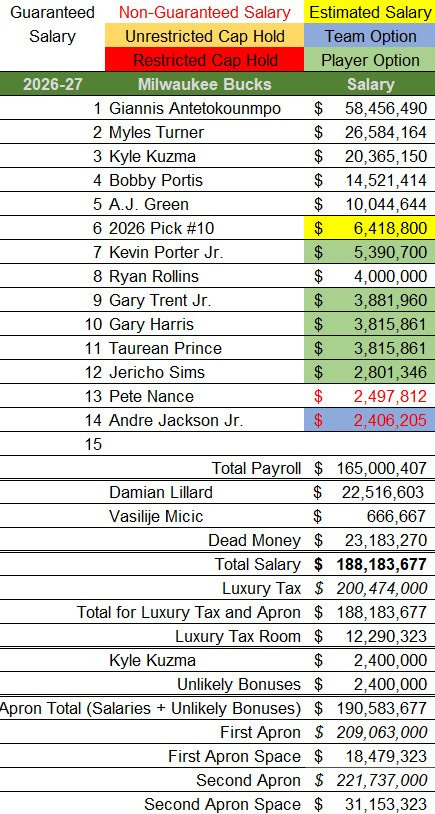
The Bucks are entering the offseason with 14 players under contract, totaling $165 million in salaries. They also have an additional $23.2 million in dead salary, headlined by Damian Lillard’s stretched money over the next four seasons. This leaves them with roughly $15 million below the luxury tax line when factoring in the $2.3 million setoff they’ll receive from Lillard signing with the Trail Blazers.
They’ll likely have more tax space once their pending options and non-guarantees are accounted for. Some of their players with player options will decline them and enter free agency, while the Bucks could cut one of their two non-guaranteed players. They may have closer to $25 million in room below the luxury tax once those contracts are resolved. They could create even more flexibility in an Antetokounmpo trade, as well as by moving other veterans.
In all likelihood, the Bucks will operate as an over-the-cap team that won’t exceed the $200.5 million luxury tax line. They would have many ways to significantly increase their payroll, including using expanded trade exceptions to take in more salary than they send out. They can also acquire free agents via sign-and-trade, and they would have access to the $15 million non-taxpayer mid-level exception and the $5.5 million bi-annual exception. Using any of those tools would hard cap them at the $209.1 million first apron.
There is a slight possibility that the Bucks operate as a cap space team. It would require them to trade Antetokounmpo early and in a multi-team deal in which they take back minimal salary. The more teams involved, the fewer salaries they would need to take back.
As an example, reducing their payroll by $40 million would create $30 million in cap space while still being able to re-sign Ousmane Dieng at around his qualifying offer. They would have the $9.3 million room mid-level exception instead of the $15 million mid-level, and no access to the bi-annual exception.
This pathway would maximize the long term, since it could give them more draft equity in the Antetokounmpo trade and set them up to take on bad salary for more assets later using their cap space. The cost would be not filling out their payroll with higher-paid veterans. That would leave the roster light overall, which would only benefit the Pelicans or Hawks since one of them will get the Bucks’ 2027 first-round pick.
The alternative way to maximize their return would be to structure the deal so that they create a massive trade exception. That would allow them to get draft picks, young players, and veterans, all while preserving the ability to absorb additional salaries later. The Bucks would have one year to use the trade exception instead of cap space, and they would still reap the benefits of the additional spending power of an over-the-cap team, such as the $15 million mid-level exception.
