

The Nuggets' Complicated Path Forward - 2026 Offseason Preview
A deep dive on the Nuggets troubled salary cap situation and how their roster-building restrictions, luxury tax concerns, and lack of tradeable draft picks could spur a major shakeup to their core.

The Nuggets are now three seasons removed from their championship and appear to be at a major crossroads. Despite not making it back to the conference finals, their core around Nikola Jokic, Jamal Murray, and Aaron Gordon showed enough fight in the playoffs to justify sticking with it. It took time for their key players to peak around the same time, coinciding with a 12-game winning streak to end the season. If everything broke right, it felt like they had a path back to the Finals.
That’s why their six-game first-round loss to the Timberwolves felt existential. The Nuggets have relied on having an elite offense with a hopefully average defense to be good enough to advance in the playoffs. In retrospect, they haven’t had quite as much playoff success over their past eight postseason appearances as their one title suggests. This build may have worked a few seasons ago, but it may no longer be viable in a league rewarding teams with more defensive and physical personnel.
The path forward will be difficult as long as Jokic is there. The Nuggets are facing the roster-building challenges most teams eventually encounter in the later stages of their core. They’ve needed to trade whatever few remaining draft assets they have just to create enough flexibility to remain competitive the next season. They’ll continue maximizing the roster within their tax and apron constraints, but that will likely require them to shake up the roster across multiple levels.
2026 Offseason Previews

Atlanta Hawks | Boston Celtics | Brooklyn Nets | Charlotte Hornets | Chicago Bulls | Cleveland Cavaliers | Dallas Mavericks | Denver Nuggets | Detroit Pistons | Golden State Warriors | Houston Rockets | Indiana Pacers | Los Angeles Clippers | Los Angeles Lakers | Memphis Grizzlies |
2026 Contract Projections
Current Extension Eligible Players Part 1 | Current Extension Eligible Players Part 2 | Current Extension Eligible Players Part 3 | Current Extension Eligible Players Part 4 | Standout Minimum Players | Free Agents and Pending Options Part 1 | Free Agents and Pending Options Part 2
Salary cap situation
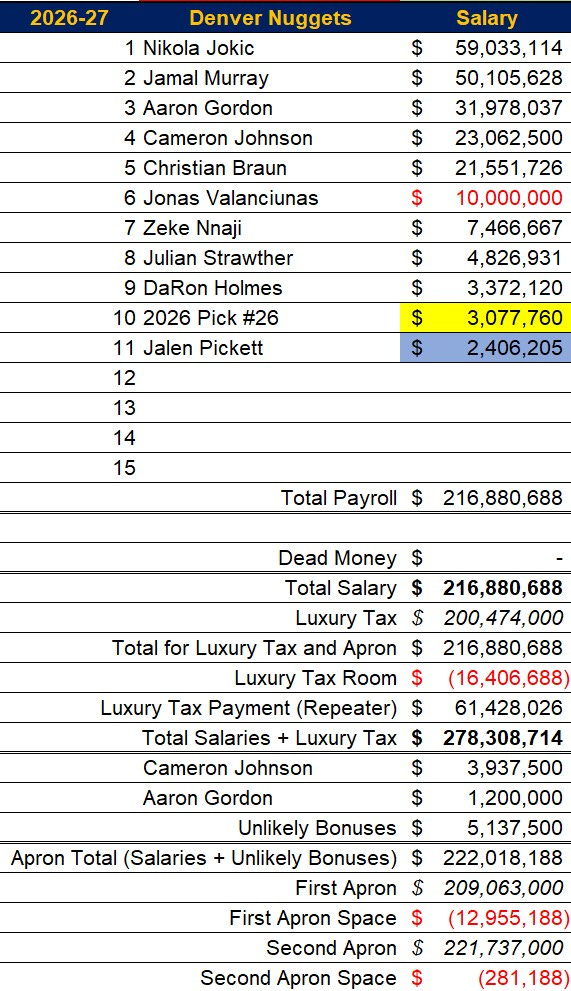
The Nuggets are heading into the offseason with 11 players rostered and a payroll totaling $216.9 million. Their current roster is already over the $200.5 million luxury tax line, $209.1 million first apron, and $221.7 million second apron. Their rising payroll is the result of Christian Braun’s five-year, $100 million extension and Aaron Gordon’s three-year, $104 million extension kicking in. They will likely need to reduce payroll to keep their roster within one of those thresholds, with the second apron being the highest they may be willing to go.
The significance of finishing the season above the second apron is twofold. One penalty for teams that finish above it is having their first-round pick seven years into the future frozen, meaning it cannot be traded. It can be unfrozen, but the team must stay under the second apron in three of the subsequent four seasons. This would be a problem for the Nuggets since it would mean freezing their 2034 first-round pick, which would otherwise become available to trade in the 2027 offseason. They may need to trade it at some point, considering how few tradeable assets they have.
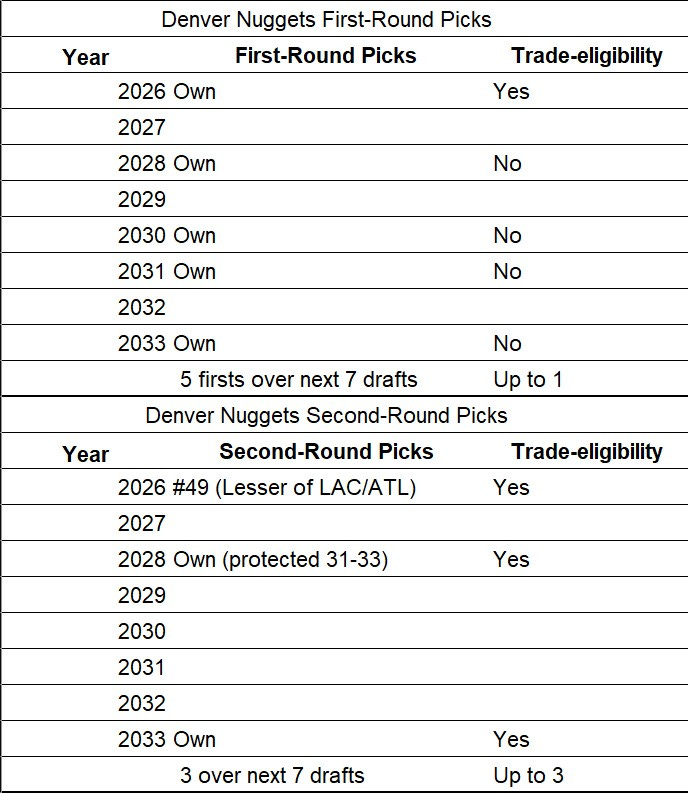
The Nuggets are severely limited in how they can improve the roster. They owe first-round picks in 2027, 2029, and 2032, preventing them from trading another future first-round pick because of the Stepien rule. They’ll only be allowed to trade the 26th overall pick in the upcoming draft, starting on draft night. Any trade they make as an apron team would require them to take back equal or less salary than they send out. They’d be limited to increasing payroll by re-signing their own free agents, signing draft picks, and adding veteran minimum contracts.
The other short-term detriment of finishing above or near the second apron is the higher luxury tax penalty. The second apron is roughly $21 million above the luxury tax line, meaning teams hovering around it are in the third luxury tax level. This is where rates spike from the first two levels, which were lowered under the current CBA to incentivize teams to pay some tax while making it significantly more punitive at the third level and above.
Their repeater status further complicates the tax situation. The Nuggets were taxpayers from 2022-23 through 2024-25, all under the previous, less punitive system. They paid a combined $58 million in penalties over those three seasons. That is a modest amount over a three-year period when considering that teams like the Warriors, Clippers, and Nets paid more than that total in at least one season this decade.
The Nuggets became repeat taxpayers for the 2025-26 season since they were taxpayers in three of the previous four seasons. This was a significant motivator in the decision to trade Michael Porter Jr. and their 2032 first-round pick for Cameron Johnson. They were facing a $30 million penalty as a repeat taxpayer, a frozen 2033 first-round pick, and no roster-building flexibility if they ran it back. The $17 million payroll decrease from the trade not only subsidized trading for Jonas Valanciunas but put them in a position to duck the tax entirely.
The trade saved the Nuggets nearly $55 million in 2025-26 when factoring in the payroll savings and the luxury tax distribution non-taxpaying teams receive. They are still subject to repeater rates if they are taxpayers this upcoming season. They could conceivably look to avoid the luxury tax one more time, which would set them up with standard tax rates between 2027-28 and 2029-30. That would give them a better chance to maximize the roster around Jokic during the length of his upcoming extension.
The Nuggets’ impending tax crunch is why they cannot simply re-sign Peyton Watson without reducing payroll first. Their luxury tax penalty is projected at just north of $100 million if they don’t re-sign him and mainly run the remaining roster back after reaching 14 players. They could reduce that amount to $60 million if they trade or stretch Jonas Valanciunas, who is on a partially guaranteed contract.
Even if they do that and squeeze Watson in restricted free agency at a lower-end, conservative starting salary, their tax penalty would approach $160 million. That’s because they’d be in the sixth luxury tax level, requiring repeat taxpayers to pay $7.75 per $1 over the tax, with the previous five levels maxing out at a combined $156 million. That effectively means re-signing Watson while keeping all of their starters would cost them around $120 million next season.
