

Elevating the Pistons to True Title Contenders - 2026 Offseason Preview
On the Pistons' offseason, the contractual and long-term situations for Jalen Duren and Ausar Thompson, cap space vs over the cap, and how they could get Cade Cunningham his co-star.

The Pistons continue to blast through expectations. After going from one of the worst teams in the league to a six seed last season, many expected them to remain at a similar level or improve only marginally, given they made no significant upgrades in the offseason. That thinking felt justified after their hot start kept them as the top seed in the East, including a 13-game winning streak.
It seemed like they had a golden opportunity to seize the Eastern Conference by making a trade that could put them over the top. Jaren Jackson Jr. was available, but was he the player they should have pushed their chips in for? And were there any other big-name targets truly available? Ultimately, they didn’t need to make a significant change considering how well they were already playing. A 60-win season and a first-round series win are enough progress while they continue to develop their core.
In other words, the Pistons chose not to raise expectations prematurely with a big trade. But those expectations have risen now heading into the 2026-27 season, and it’s abundantly clear that Cade Cunningham needs help. Whether it’s an All-Star on a big contract or a starting-level player on a more manageable salary, they need to give him one or two players who can create their own shot and create for others. That, along with figuring out contracts for Jalen Duren and Ausar Thompson and their long-term future with them, makes them one of the most fascinating teams to follow this offseason.
2026 Offseason Previews

Atlanta Hawks | Boston Celtics | Brooklyn Nets | Charlotte Hornets | Chicago Bulls | Cleveland Cavaliers | Dallas Mavericks | Denver Nuggets | Detroit Pistons | Golden State Warriors | Houston Rockets | Indiana Pacers | Los Angeles Clippers | Los Angeles Lakers
2026 Contract Projections
Current Extension Eligible Players Part 1 | Current Extension Eligible Players Part 2 | Current Extension Eligible Players Part 3 | Current Extension Eligible Players Part 4 | Standout Minimum Players | Free Agents and Pending Options Part 1 | Free Agents and Pending Options Part 2
Salary cap situation and draft assets
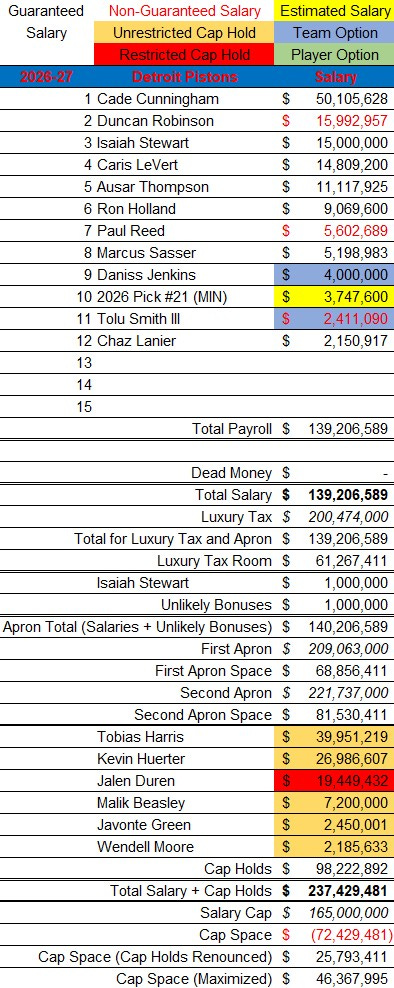
The Pistons are entering the season with a fluid salary cap situation. They have 12 players under contract, totaling $139.2 million in salaries. Of those salaries, just $113.2 million is guaranteed. That would put them significantly under the $165 million salary cap, with the ability to create a maximum of $46 million.
However, those projections would require the Pistons to sacrifice a significant chunk of their roster, including the Bird rights to Duren. They would have to renounce free agent cap holds to access cap space, and then they couldn’t re-sign those players unless it was with cap space or the $9.3 million room mid-level exception. But they probably would be moving on from those free agents anyway if they’re trying to sign a big-name free agent.
Duren’s cap hold won’t be renounced, or the Pistons won’t be able to make him a restricted free agent. They could have around $26 million in cap space while retaining his $19.4 million cap hold. They’d be able to spend that amount in free agency, then go over the salary cap to re-sign him up to his maximum amount. But it would also require them to make additional sacrifices, such as waiving or trading Duncan Robinson, who has a $2 million partial guarantee, along with other non-guaranteed players like Paul Reed and Tolu Smith III.
$26 million isn’t a lot of cap space nowadays and is far below the $41.25 million maximum salary they could give one of the best free agents. They could get closer to that amount by trading an additional mid-level salary, like Caris LeVert. Then they could make an aggressive offer to one of the top free agents available, such as Austin Reaves. Signing an All-Star-caliber player like him could justify sacrificing the depth required to create cap space.
The Pistons’ proximity to the salary cap puts them in a fascinating situation. They do not need to decide whether to operate as a cap space team until after the moratorium ends on July 6. They could technically negotiate with a top free agent before that, starting on June 30, as if they have cap space. If they can come to an agreement with the player, they can then go ahead and make the subsequent moves needed to create the cap space for the signing.
Operating as a hedging cap space team could also potentially help them leverage a sign-and-trade for a top free agent. If they come to terms on a contract that the player’s previous team doesn’t want to match, they could agree to sign-and-trade him to the Pistons for minor draft equity. That would be advantageous because they could do it without using cap space. Executing a sign-and-trade as an over-the-cap team would give them more resources to maintain a deeper roster.
