

Why the Raptors May Be Stuck in the Middle - 2026 Offseason Preview
On the Raptors' salary cap situation, roster-building options, draft assets, key players with impending contract decisions, and why their bad contracts may result in a quiet summer on the trade front.

The post-2019 title seasons have been rough for the Raptors. They missed the playoffs in four of the following six seasons and refused to enter a full-scale rebuild. Instead, they held onto veterans and replaced them with others in an attempt to push back into the playoffs. After winning a title with no lottery picks, it’s understandable why they felt they had enough to compete for one after selecting a great one in Scottie Barnes.
Eventually, the Raptors had to trade their core ahead of impending free agency because of their contract demands. The return for OG Anunoby featured veterans ready to push them forward, and the return for Pascal Siakam featured draft picks that were eventually traded for veterans. The result is a roster that is likely capped as a true title contender but still strong enough to be relevant in the East. They got what they paid for, but it resulted in an expensive, top-heavy roster.
The Raptors should face tougher competition next season with more teams in the East on the rise. They’ll need to be proactive and address some of their flaws if they’re going to keep their spot or at least remain in the playoffs. Their work will be cut out for them, given the multiple unattractive contracts they have to offer in trades. They’ll need to weigh being aggressive with their draft assets to stay afloat against remaining mildly competitive as is and banking on lottery reform to reward them.
2026 Offseason Previews

Atlanta Hawks | Boston Celtics | Brooklyn Nets | Charlotte Hornets | Chicago Bulls | Cleveland Cavaliers | Dallas Mavericks | Denver Nuggets | Detroit Pistons | Golden State Warriors | Houston Rockets | Indiana Pacers | Los Angeles Clippers | Los Angeles Lakers | Memphis Grizzlies |
2026 Contract Projections
Current Extension Eligible Players Part 1 | Current Extension Eligible Players Part 2 | Current Extension Eligible Players Part 3 | Current Extension Eligible Players Part 4 | Standout Minimum Players | Free Agents and Pending Options Part 1 | Free Agents and Pending Options Part 2
Salary cap situation and draft assets
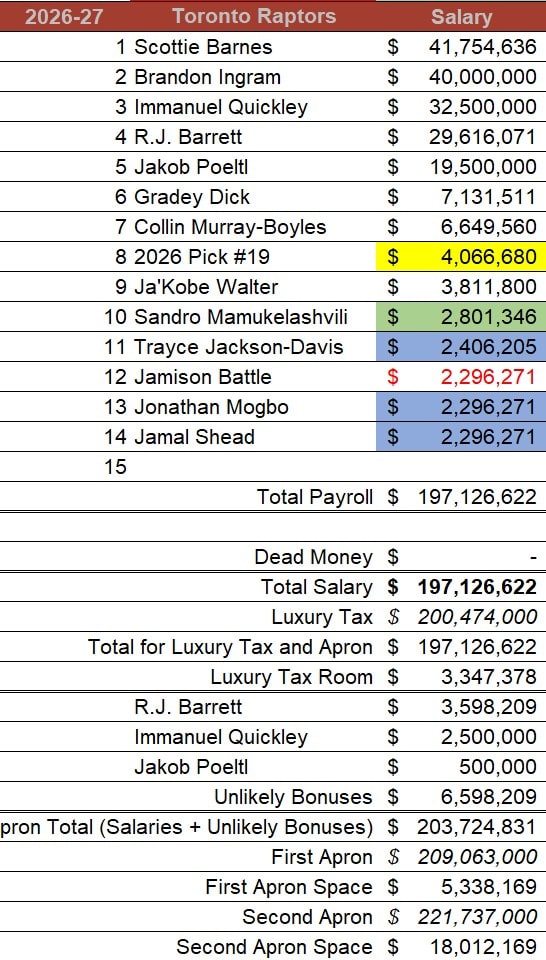
The Raptors are heading into the offseason with a nearly full roster and a combined $197 million payroll. They will operate as an over-the-cap team that is likely to remain under the $209.1 million first apron. This would give them access to several roster-building tools, such as taking on more salary in a trade than they send out and using the $15 million non-taxpayer mid-level exception.
In all likelihood, the Raptors will also remain under the $200.5 million luxury tax line. They are currently just $3.3 million below that threshold with the roster as is. They could sign a 15th player to a minimum salary contract as their lone offseason move and remain below it. Unless they acquire a superstar who puts them in true title contention, as the Kawhi Leonard trade did, they are unlikely to be taxpayers.
At the same time, they won’t let tax concerns hold them back from making their moves. They’ve shown time and time again that they’re comfortable going over the luxury tax and even the first apron to start the season. They were above both thresholds last season and got under them by trading Ochai Agbaji with a second-round pick to the Nets. They’ll only be penalized if they finish the season above the luxury tax threshold.
The Cavaliers series revealed a lot of positives about the Raptors’ roster. Barnes emerged as a playoff riser on offense for a team in desperate need of a player who could score. Collin Murray-Boyles may be the second-most important player in their long-term outlook. Ja’Kobe Walter and Jamal Shead look like promising rotation players worth investing more into. And R.J. Barrett may have gone from a trade candidate all season long to an integral part of their nucleus.
They got little to nothing from their remaining starters. Brandon Ingram was neutralized in the series, shooting just 33 percent from the field. Jakob Poeltl saw significantly reduced minutes in favor of smaller and more versatile lineups. Immanuel Quickley didn’t play, and maybe the Raptors could’ve won the series if he had. Overall, the Raptors effectively got negative playoff value from 60 percent of their usual starters.
The Raptors need to get a lot more from their starters. They have a top-heavy payroll, with Ingram, Poeltl, and Quickley occupying approximately 46 percent of their cap against the luxury tax. But the group is still a questionable fit with a limited ceiling, even if mostly healthy, and enough things break right for them. They can give this group another year, but it feels like they’re heading toward the conclusion that they’ll need to modify their lineup, especially if their playoff spot is threatened by teams like the Pacers, Heat, and Hornets.
They’ll be on the lookout for upgrades, but actually executing a trade that makes sense is easier said than done. The Raptors were heavily rumored to be in discussions for an upgrade at center, having been linked to players like Jaren Jackson Jr., Anthony Davis, and Domantas Sabonis. No deal materialized because of the negative value of the contracts they would logically need to send out to make a trade work. They would need to trade draft equity not just to acquire their target, but possibly also to incentivize a team to take on some of their players.
