

Unpacking the Houston Rockets' Outlook - 2026 Offseason Preview
On the Rockets, their complicated salary cap situation, their draft pick surplus, impending contract decisions, and how they could address the underlying tensions of their incompatible timelines.

The Rockets are now three seasons removed from their rebuild, and the results have been simultaneously encouraging and worrying. They made a meteoric leap last season, going from a .500 team that barely missed the Play-In Tournament to a two-seed that lost in a hard-fought first-round series. In need of more shooting and spacing, they acquired Kevin Durant for a relatively low price. It accelerated their timeline and raised expectations, but it also validated the front office’s belief in its young core.
The 2025-26 season was volatile in a way that fans and the organization probably did not enjoy experiencing. The Rockets faced adversity before the season even began when Fred VanVleet was ruled out for the year with a torn ACL. They still started strong, with the league’s top offense for much of the season. But some players regressed as the season went on, their recent additions did not contribute much, and their depth took another hit when Steven Adams suffered a season-ending injury.
Growing pains are expected for a roster built around such a young core. On the surface, winning 52 games and remaining in the top six in a loaded Western Conference is still impressive considering the injuries. But the season also may have revealed flaws that a fully healthy roster would not automatically fix. Their trajectory feels like it has plateaued for the time being after a second straight first-round exit.
They will likely run it back next season with a healthier roster so they can better determine who is part of the long-term core and who is expendable. Either way, they are inching closer to accelerating an already expedited timeline.
2026 Offseason Previews

Atlanta Hawks | Boston Celtics | Brooklyn Nets | Charlotte Hornets | Chicago Bulls | Cleveland Cavaliers | Dallas Mavericks | Denver Nuggets | Detroit Pistons | Golden State Warriors | Houston Rockets | Indiana Pacers | Los Angeles Clippers | Los Angeles Lakers | Memphis Grizzlies |
2026 Contract Projections
Current Extension Eligible Players Part 1 | Current Extension Eligible Players Part 2 | Current Extension Eligible Players Part 3 | Current Extension Eligible Players Part 4 | Standout Minimum Players | Free Agents and Pending Options Part 1 | Free Agents and Pending Options Part 2
Salary cap situation
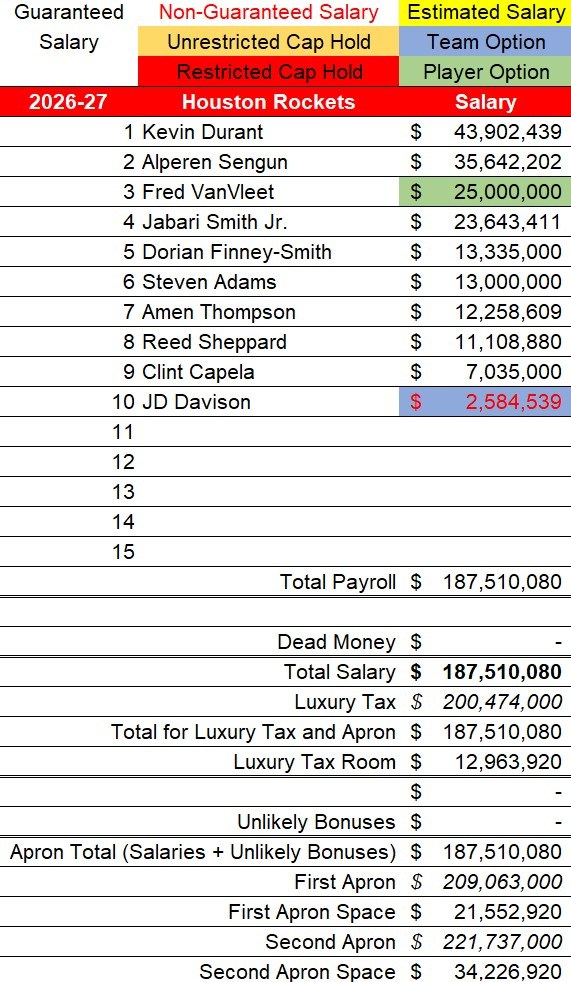
The Rockets are heading into the season with 10 players on the roster and a combined payroll of $187.5 million. They will operate as an over-the-cap team, just like they did last season. The bigger question is how much they are willing to spend.
Last offseason, they maximized their flexibility under the first apron hard cap, which teams must stay below to use roster-building mechanisms like the non-taxpayer mid-level exception and expanded trade exceptions. By finishing just below the first apron, they paid the luxury tax for the first time since the 2015-16 season. They only paid a $7.2 million penalty, which is not much, but it was still an encouraging sign that ownership is willing to pay some tax in a league where many contenders are abstaining.
The bigger long-term issue is the repeater clock. If the Rockets are taxpayers again in the 2026-27 and 2027-28 seasons, they would be subject to repeater taxpayer status starting in 2028-29. That is a more significant obstacle in the new CBA than the second apron, as the higher tax rates could force them to scale back spending or rethink the roster. For now, it seems more likely that they will go above the luxury tax line, at least to start the season.
The Rockets finished only $6.9 million above the luxury tax line last season, close enough that they could have made a deadline trade to duck it. Doing so probably would have required trading one of their core players. Even if they had traded all of Jae’Sean Tate, Aaron Holiday, Josh Okogie, and Jeff Green without taking back salary, they would have gone back over the tax line once they replaced those roster spots.
They would go above the tax line if re-signing Tari Eason were their only major move of the offseason, even at a lower-than-expected average annual salary. They would be hard-pressed to finish under the tax when factoring in the roster spots they still need to fill to reach the 14-player minimum. It should be easier for them to get under the tax this season by moving a player like Dorian Finney-Smith, whose salary is not guaranteed beyond next season.
There is a possibility that the Rockets’ proximity to either apron, combined with Eason’s restricted free agency, could hold their offseason hostage. Last offseason, for example, the Warriors did not make a single transaction until Jonathan Kuminga’s situation was resolved just before his qualifying offer was set to expire on October 1. They did not want to give any team an opening to sign him to an offer sheet they could not match because of the second apron hard cap they would become subject to by signing Al Horford with the taxpayer mid-level exception.
