

Another Challenging Summer for the Suns - 2026 Offseason Preview
On the Suns' upcoming offseason, their salary cap situation, impending contract decisions, and why they should consider changing course and trading veterans, including Devin Booker.

Perhaps no team in NBA history raised its expectations as quickly and aggressively as the Suns did in 2023. They leveraged themselves to the maximum extent possible, having traded all the first and second-round picks they could to acquire Kevin Durant, Bradley Beal, and the rest of the roster. They could keep the team together for the first two seasons before roster expenses would’ve approached half a billion dollars for the 2025-26 season. That made 2023-24 and 2024-25 championship or bust.
The underwhelming return for Durant relative to what they gave up to acquire him, coupled with mostly marginal additions to the roster, left us with the impression that they could be headed to the lottery. Instead, they were one of the biggest surprise teams of the season with a top 10 defense and overachieving their preseason wins total by 14.5 games. Perhaps what they needed the most was a culture reset and a head coach in Jordan Ott to effectively motivate his players to play hard every night.
The Suns could bring back the group, make more marginal upgrades, and remain a respectable team that may or may not make the playoffs. But that’s about it. Understanding that this version of the team is likely at its ceiling, the Suns should seriously consider accumulating draft picks and young talent by trading their best players, including Devin Booker.
2026 Offseason Previews

Atlanta Hawks | Boston Celtics | Brooklyn Nets | Charlotte Hornets | Chicago Bulls | Cleveland Cavaliers | Dallas Mavericks | Denver Nuggets | Detroit Pistons | Golden State Warriors | Houston Rockets | Indiana Pacers | Los Angeles Clippers | Los Angeles Lakers | Memphis Grizzlies |
2026 Contract Projections
Current Extension Eligible Players Part 1 | Current Extension Eligible Players Part 2 | Current Extension Eligible Players Part 3 | Current Extension Eligible Players Part 4 | Standout Minimum Players | Free Agents and Pending Options Part 1 | Free Agents and Pending Options Part 2
Salary cap situation and assets
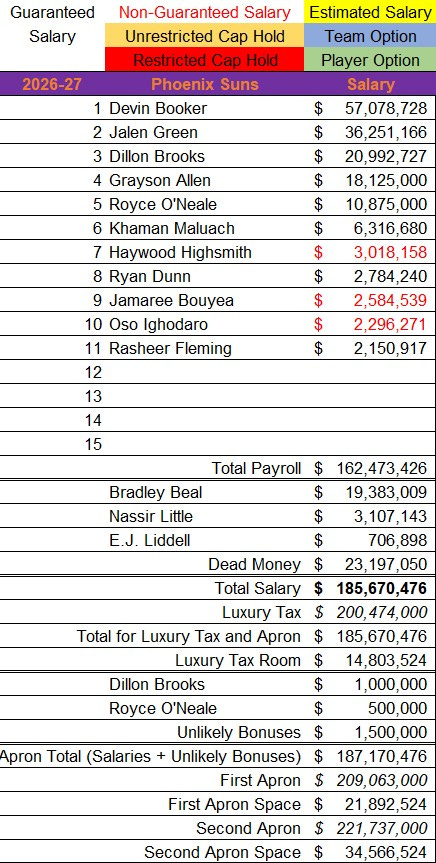
The Suns are entering the 2026 offseason with 11 players rostered for a combined $185.7 million payroll. That includes $23.2 million in dead money, including a $19.4 million cap hit for Bradley Beal that runs through 2030. They will operate as an over-the-cap team, but that excessive dead money leaves them just $14.8 million below the projected $200.5 million luxury tax line for 2026-27.
Owner Mat Ishbia went on record last week saying he will not trade Booker. The next thing he’ll need to decide is how much he’s willing to spend on the roster, particularly if that means going into the luxury tax again. The Suns would still be in the repeater tax, meaning they’d pay significantly higher rates if they finish the season above the tax line. They got in position to duck the tax last season by waiving and stretching Beal, reducing their payroll by over $30 million.
The more important aspect of the Suns’ willingness to spend is how it affects the strength of the roster. $14.8 million is not a lot of flexibility. They won’t be able to keep any of their top free agents and field a roster that meets the 14-player minimum while staying below the luxury tax line. That leaves them with two options in determining what kind of over-the-cap team they’d like to be.
The first is to operate above the luxury tax line and the $209.1 million first apron, but below the $221.7 million second apron. They are $34.6 million below the second apron, which may be enough to re-sign all three free agents. They may need to reduce payroll slightly to fit the entire roster within that threshold, but it’s the path of least resistance to running it back. They’d also get access to the $6 million taxpayer mid-level exception, which would hard cap them to the second apron.
The other option is to operate below the $209.1 million first apron and, to a similar extent, the luxury tax line. If they stay below the first apron, they’d have access to the $15.1 million non-taxpayer mid-level exception, the ability to acquire free agents via sign-and-trade, and expanded trade exceptions that allow them to take back more salary than they send out. But those tools may not matter much if their top objective is free agent retention under a strict budget.
The Suns would still need to reduce payroll significantly to keep several of their top free agents while remaining below the luxury tax line. That would require trading at least one of their mid-level salaried players, like Grayson Allen ($18.1 million) or Royce O’Neale ($10.9 million). O’Neale’s two years, $22.5 million, should be easier to offload than Allen’s remaining two years, $37.5 million.
They would likely need to offload both Allen and O’Neale if they want to retain all their top free agents and have additional flexibility to upgrade the roster while remaining below the luxury tax line. That could include using the mid-level exception or taking on more salary in a trade. Otherwise, bigger changes to the roster for next season would require dollar-for-dollar trades or sending out more money than they take back.
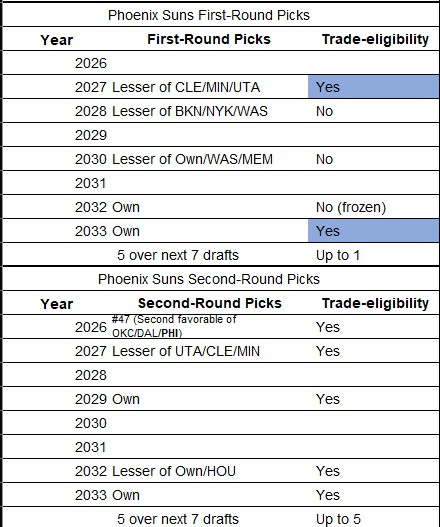
The Suns are limited in the amount of assets they can use to upgrade the roster while decreasing payroll. They have five first-round picks over the next seven drafts and can only trade a maximum of two. One is their 2027 first-round pick, which is the lesser of the Cavaliers, Timberwolves, and Jazz picks. That one can be traded at the conclusion of the 2026 draft.
The other is their 2033 first-round pick, which, like any draft pick seven years in the future, holds a lot of extrinsic value. They’ve shown a willingness to trade draft picks that far out, including their 2031 first-round pick for three first-round picks of lesser value. It is their most valuable tradeable asset, so if they move it, they’d need to receive commensurate value, if not more than what they got for the 2031 first-round pick. The new proposed lottery reform significantly increases the chance that a mid-first-round pick jumps to the top of the draft.
Why the Timing is Bad to Start the 3-2-1 Lottery

The NBA is set to vote on a lottery reform proposal called the “3-2-1 lottery.” It would be a radical change that fundamentally alters how the league allocates top draft picks.
