

Resolving the Thunder's Expensive Roster - 2026 Offseason Preview
On the Thunder's upcoming offseason, apron restrictions, luxury tax concerns, which players could be on the move to reduce it, & why more rotation liquidation could occur over the next three seasons.

The Thunder’s campaign to win a second consecutive championship got off to a blistering start, including a 24-1 start and a 16-game win streak. Then they faced the Spurs in December and lost to them three times. They were the first team to give them real problems, and they bled into their matchup in the Western Conference Finals. They ultimately lost in what was a close series that proved that, as deep as their roster is, they will have a real challenger over the next few years in their quest to return to the Finals.
Did that series expose anything existential about the Thunders’ roster? Probably not. Chet Holmgren’s disappearing act is a cause for concern with his maximum contract set to kick in, but the grass isn’t always greener if they trade him. The bigger concern was injuries, but they got so much out of guys stepping up with Jalen Williams and Ajay Mitchell out. The injury pendulum will eventually swing in the other direction. They don’t need to make major changes, at least not to the top of their roster.
The Thunder are all but certain to make some changes to the backend of their rotation. They have a roster crunch and enormous roster expenses to run the team completely back. They are going to be significant taxpayers, but to a reasonable extent. They’ll still field one of the deepest rosters in the league, but perhaps they may not be 13-deep as they were last season.
2026 Offseason Previews

Atlanta Hawks | Boston Celtics | Brooklyn Nets | Charlotte Hornets | Chicago Bulls | Cleveland Cavaliers | Dallas Mavericks | Denver Nuggets | Detroit Pistons | Golden State Warriors | Houston Rockets | Indiana Pacers | Los Angeles Clippers | Los Angeles Lakers
2026 Contract Projections
Current Extension Eligible Players Part 1 | Current Extension Eligible Players Part 2 | Current Extension Eligible Players Part 3 | Current Extension Eligible Players Part 4 | Standout Minimum Players | Free Agents and Pending Options Part 1 | Free Agents and Pending Options Part 2
Salary cap situation
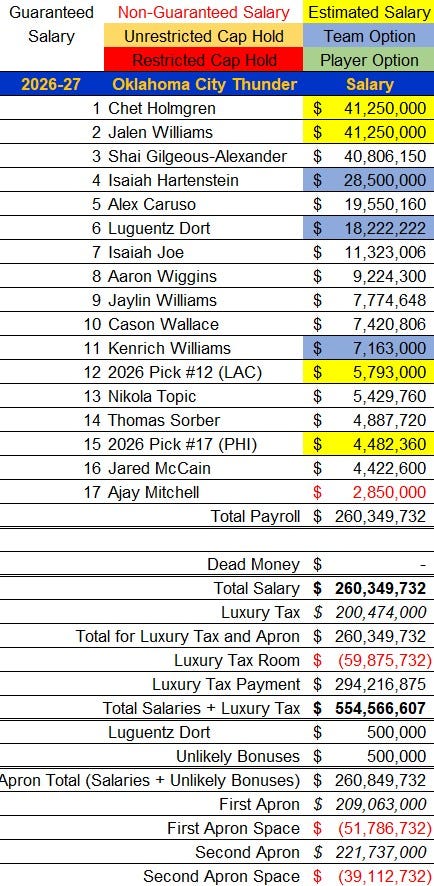
The Thunder are entering the offseason with 17 players rostered, including two first-round picks in the 2026 Draft. The total salaries combine to what would be a record-setting $260 million payroll, which would push them $60 million above the luxury tax line. The spike in their payroll is the result of the maximum extensions of Chet Holmgren and Jalen Williams kicking in. They will have starting salaries projected at $41.25 million, which is worth 25 percent of the $165 million salary cap.
The $294 million luxury tax penalty is disingenuous when factoring in that they can’t field 17 players. If, at a minimum, they decline Kenrich Williams’ $7.2 million team option and trade the 17th overall selection for a future first-round pick, then they’re working with a $207 million tax penalty. They’re effectively facing a $450 million roster if they run it back and use their last roster spot on just one of their first-round picks.
Even so, that tax penalty is historically high and accounts for about 83 percent of their total payroll. Teams with exorbitant tax penalties that get closer to matching their total payroll don’t receive great returns on investment. The only time a team paid close to a 1:1 tax penalty to payroll is the 2022 Warriors, and that thankfully resulted in a championship. In all likelihood, the diminishing returns on keeping their 12th and 13th guys won’t justify the $100 million or so in additional costs.
The Thunder will be taxpayers in the upcoming 2026-27 season. The bigger question is how much is ownership willing to spend? They’ve shown a strong willingness in the Paul George years when they had one of the biggest tax penalties in history up until that point. Chances are, they would go just as far with a roster spending $100 million or less in the luxury tax than a roster $200 million or above.
