

The Challenges of Upgrading the Wolves Roster - 2026 Offseason Preview
On the Timberwolves upcoming offseason, their salary cap and apron limitations, Ayo Dosunmu's free agency, and what would be required from them to trade for a significant upgrade.

The Timberwolves couldn’t reach the Western Conference Finals for a third consecutive season, but they continue to exceed expectations since the Rudy Gobert trade. They’ve had nearly as much success over the past four years as they did in the rest of this century before that stretch. They got exactly what they hoped for: a great team that will compete in the playoffs and occasionally make a deep run.
After four years without a Finals appearance, the Timberwolves may need to reevaluate things. The top of the Western Conference has shifted in a way they couldn’t have anticipated when they put this team together. They’ll continue to make the playoffs with this group, but they may stagnate or even regress if they remain complacent. President of basketball operations Tim Connelly said himself that he’s not satisfied with this year’s second-round exit and will be as aggressive as possible if needed to improve the roster.
The Timberwolves can be as aggressive as they’d like on the trade market and in free agency, but they’ll have challenges. They lack the tradeable assets to make a meaningful offer for the best veterans and the cap flexibility to make a big enough offer to the top free agents. They might be able to swing a trade to upgrade their starting lineup, but their offseason may be limited to retaining their depth and making marginal moves to solidify their rotation.
2026 Offseason Previews

Atlanta Hawks | Boston Celtics | Brooklyn Nets | Charlotte Hornets | Chicago Bulls | Cleveland Cavaliers | Dallas Mavericks | Denver Nuggets | Detroit Pistons | Golden State Warriors | Houston Rockets | Indiana Pacers | Los Angeles Clippers | Los Angeles Lakers
2026 Contract Projections
Current Extension Eligible Players Part 1 | Current Extension Eligible Players Part 2 | Current Extension Eligible Players Part 3 | Current Extension Eligible Players Part 4 | Standout Minimum Players | Free Agents and Pending Options Part 1 | Free Agents and Pending Options Part 2
Salary cap situation and draft picks
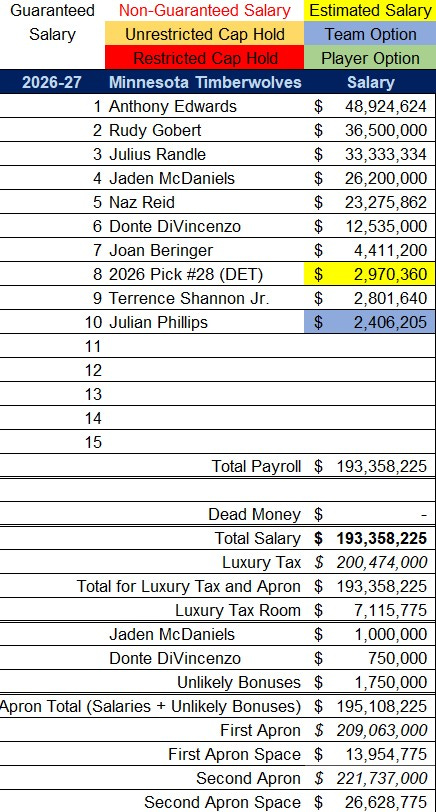
The Timberwolves are entering the offseason with 10 players under contract, totaling $193.4 million in salary. They will operate as an over-the-cap team and, in all likelihood, be over the luxury tax again. They are just $7.1 million below the $200.5 million luxury tax threshold, but they will exceed it when they presumably re-sign Ayo Dosunmu. Even if they let him go, they would exceed it simply by signing four players to veteran minimum salaries.
Not only will the Timberwolves be above the luxury tax, but they’ll likely also be an above-apron team. They operated above the second apron in 2024-25 and above the first apron in 2025-26 before getting below it at the trade deadline. The bigger question is whether they’re willing to go above the second apron again, finish above the first and below the second, or find a way to remain below the first.
Teams below the first apron have the most access to resources to improve the roster. They can use expanded trade exceptions to take in more salary than they send out. They can also sign-and-trade for free agents, use the $15 million mid-level exception, and use the $5.5 million bi-annual exception. The Timberwolves would be unable to exceed the $209.1 million first apron if they use any of these mechanisms.
This path seems unlikely because it would require the Timberwolves to reduce their payroll significantly. For example, they could dump Julius Randle’s $33 million salary into another team’s cap space, then use a combination of the exceptions listed above to fill out the roster under the first apron. They seem more likely to use their big salaries in trades to acquire desired targets than to offload those salaries to pursue smaller pieces later.
Teams above the second apron are limited to increasing their payroll by re-signing or extending their own players, signing draft picks, and signing minimum-salary players. The bigger issue is that the Timberwolves wouldn’t be able to aggregate multiple players in a trade or sign and trade free agents to create outgoing salaries to acquire a more expensive one. They’d also have their 2034 first-round pick frozen or become unable to trade it. This already happened to their 2032 first-round pick because they finished above the second apron in 2024-25.
Operating above the first apron and below the second apron feels like the sweet spot for the Timberwolves. They wouldn’t be able to use expanded trade exceptions, they’d have the $6 million taxpayer mid-level exception instead of the $15 million version, and they’d lose access to their trade exceptions, including the $10.8 million one they created for Mike Conley last year. But they wouldn’t face draft-pick penalties and would have a significantly lower luxury tax penalty.
Most importantly, the Timberwolves would be able to aggregate multiple salaries in a trade for a more expensive player, as long as the incoming salary doesn’t exceed 100 percent of their outgoing amount. This is their best path toward making a significant upgrade to the roster while maintaining a strong level of depth.
