

How the Blazers are Poised for a Major Leap - 2026 Offseason Preview
On the Blazers' upcoming offseason, their salary cap situation, draft assets, impending contract decisions, and how they can make multiple significant upgrades to the roster.

After four straight losing seasons and trips to the draft lottery, it was time for the Trail Blazers to transition back toward competition. Things looked shaky early in the 2024-25 season, with little progress to show from several recent draft picks. Then they had a relatively strong second half, going 23-18, fueled by a major improvement from Deni Avdija. They also established an identity in the process with a defensive-first play style.
That gave the Blazers enough proof of concept to take a step toward the Play-In Tournament. They didn’t shake up the roster, but they added Jrue Holiday, who fit their culture and gave them a much-needed veteran presence. Their direction should feel validated after a successful season filled with adversity. They were challenged from the start by an abrupt coaching change and significant injuries throughout the roster. Making the playoffs after what they went through, including an extended period without a backcourt, is a major accomplishment.
The Blazers are now entering what may be their most pivotal offseason in at least a decade. They have significant spending flexibility to upgrade the roster and maintain a high level of depth. They also have a surplus of draft picks that should put them in play for any of the top available players this offseason. They need more scoring and shooting, but they should also get enough internal improvement to climb the standings and potentially become a threat to advance past the first round next season.
2026 Offseason Previews

Atlanta Hawks | Boston Celtics | Brooklyn Nets | Charlotte Hornets | Chicago Bulls | Cleveland Cavaliers | Dallas Mavericks | Denver Nuggets | Detroit Pistons | Golden State Warriors | Houston Rockets | Indiana Pacers | Los Angeles Clippers | Los Angeles Lakers | Memphis Grizzlies |
2026 Contract Projections
Current Extension Eligible Players Part 1 | Current Extension Eligible Players Part 2 | Current Extension Eligible Players Part 3 | Current Extension Eligible Players Part 4 | Standout Minimum Players | Free Agents and Pending Options Part 1 | Free Agents and Pending Options Part 2
Salary cap situation
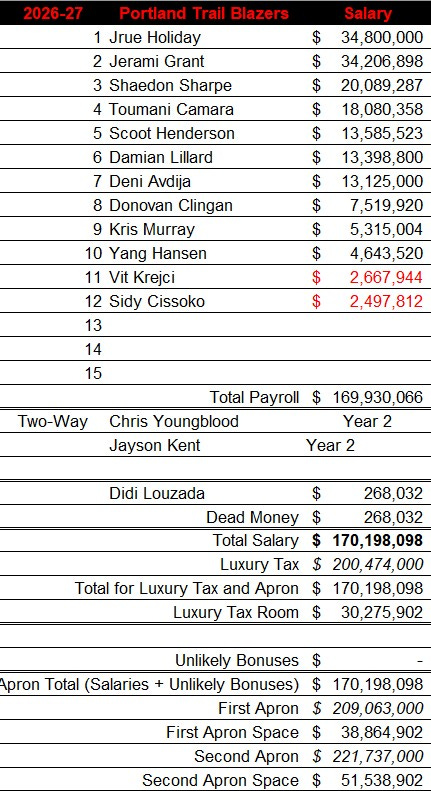
The Blazers are entering the 2026 offseason with 12 players rostered and a total payroll of $170.2 million. This will leave them with significant flexibility to upgrade the roster as an over-the-cap team. They’ll be able to re-sign their top free agents with Bird rights, use the $15.1 million non-taxpayer mid-level exception, sign-and-trade for free agents, and take in more salary than they send out with expanded trade exceptions.
The Blazers could operate as a cap space team, something Third Apron has explored for the sole purpose of renegotiating and extending Deni Avdija. They’d probably only need around $10 million to get the ball rolling, which could be created by reducing payroll through trading a player like Jerami Grant for someone cheaper. The idea would be to pay Avdija up front in exchange for annual salaries well below his maximum allowable amount.
That path is looking unlikely this summer. Avdija can only renegotiate and extend his contract during a brief period between October 1 and the day before the start of the regular season. That would require the Blazers to hold their offseason hostage and avoid moves so they could preserve cap space for three months, just to renegotiate his deal. They’ll likely prioritize strengthening the roster and could explore renegotiating Avdija in the 2027 offseason, when he has one year left on his deal.
The Blazers will be $30.3 million below the $200.5 million luxury tax line, which is the threshold they’re unlikely to pass this season. That could become a possibility if they become top-tier title contenders, which could take several years. Either way, that is a significant amount of flexibility toward upgrading the roster and more than most competitive teams have. They’ll be able to utilize several of the roster-building mechanisms listed earlier without entering the tax.
One of the bigger criticisms of the Blazers’ strategy over the past four seasons is that they loaded up on players they valued on contracts that were on the higher side. They believed the value of those players, and the value of their contracts around the league, was greater than what they could’ve gotten with cap flexibility. In retrospect, cap flexibility would’ve given them more draft assets had they been in the market for salary dumps. They weren’t able to extract value for players like Deandre Ayton, Jerami Grant, or Matisse Thybulle.
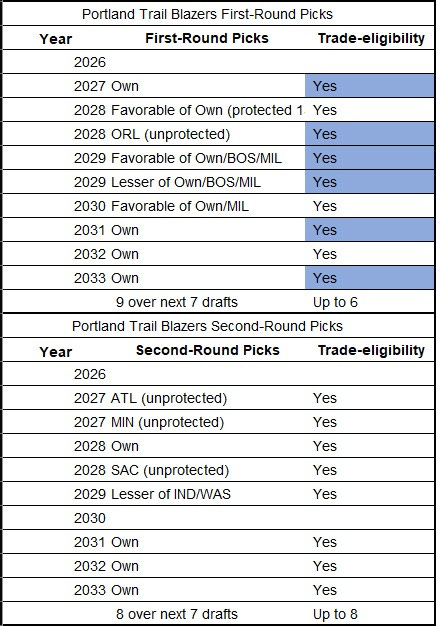
The Blazers still have a surplus of first-round picks, however, with nine over the next seven drafts. They’ll have all their own first-round picks after conveying their 2026 first-round pick to the Bulls as part of the 2021 Lauri Markkanen-Larry Nance trade. They also have two additional first-round picks, allowing them to trade up to six.
The extra picks include the Magic’s unprotected 2028 first-round pick and the more favorable pick of the Bucks or Celtics in 2029. They also have the right to swap first-round picks with the Bucks in 2028 and 2030. All these selections currently have high intrinsic value, given how poorly the Magic and Bucks seasons have gone.
It would make sense to cash in on some of these picks now, in case those teams improve. Flatter lottery odds could also decrease the value of some of these picks, especially the Bucks ones, if they become a bottom-tier team with equal odds for a top pick as several other teams. If the Blazers make an aggressive trade involving multiple first-round picks, they could hedge by including one of their own.
