

How the Jazz Payroll is Quickly Running Up - 2026 Offseason Preview
On the Jazz's upcoming offseason, how they could utilize their spending power to improve the bench, important contract negotiations, and why they're already facing tax concerns starting next season.

The Jazz rebuild was looking shaky after multiple lotteries with no luck moving up and slow development from their draft picks. For a brief period, it looked like they might have to extend their timeline even further. That changed after the late-blooming emergence of Keyonte George into an All-Star-caliber player. He, along with their belief in Ace Bailey, gave them enough confidence to push some chips in for Jaren Jackson Jr. They’re now in a desirable position for a team nearing the end of its rebuild, with a strong rotation and a top pick in the upcoming draft. They’ll finally have a chance to select another potential franchise player.
After the draft, the Jazz will have the task of strengthening the back end of their rotation. They have plenty of draft picks to trade, but will likely look to free agency to add depth. They also have several important extension negotiations to sort through and free agents of their own to bring back. Those negotiations will be crucial, as the money on their roster is quickly building up and pushing them closer to the luxury tax.
2026 Offseason Previews

Atlanta Hawks | Boston Celtics | Brooklyn Nets | Charlotte Hornets | Chicago Bulls | Cleveland Cavaliers | Dallas Mavericks | Denver Nuggets | Detroit Pistons | Golden State Warriors | Houston Rockets | Indiana Pacers | Los Angeles Clippers | Los Angeles Lakers
2026 Contract Projections
Current Extension Eligible Players Part 1 | Current Extension Eligible Players Part 2 | Current Extension Eligible Players Part 3 | Current Extension Eligible Players Part 4 | Standout Minimum Players | Free Agents and Pending Options Part 1 | Free Agents and Pending Options Part 2
Salary cap situation and draft picks
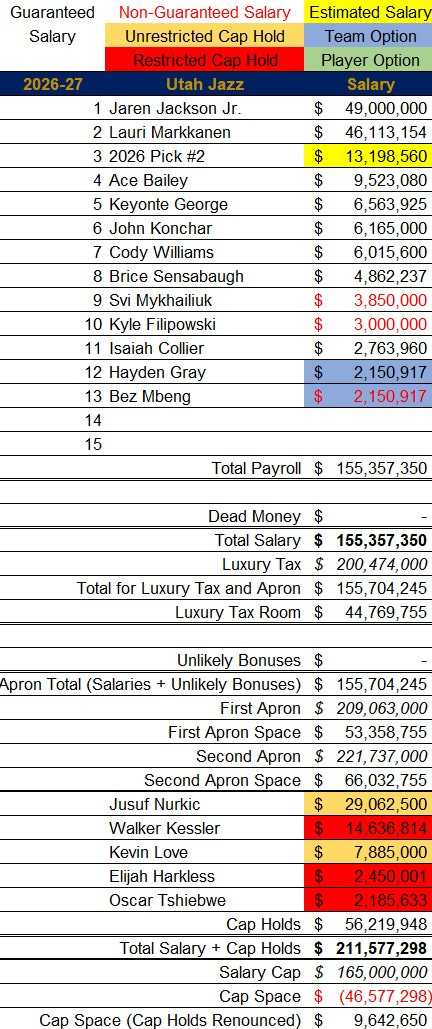
The Jazz are entering the offseason with 13 players under contract, totaling $155.4 million in salaries. That’s a low figure, placing them under the $165 million salary cap. They could get close to $17 million in cap space if they waive all of their non-guaranteed players. However, that would mean renouncing their free agent cap holds, which would prevent them from re-signing their top free agents.
The Jazz are expected to operate as an over-the-cap team so they can maintain Walker Kessler’s Bird rights. Part of the reason they weren’t in a rush to extend him last year was his low $16 million cap hold. They were projected to create significant cap space while still being able to re-sign him afterward, but they eliminated that path by trading for Jackson Jr. Kessler’s situation is now one of their top priorities this summer.
There is a path for the Jazz to create significant cap space, but it would require multiple sacrifices. They could get north of $25 million if they don’t bring back their free agents and trade players like Cody Williams and John Konchar. They could then pursue a new starting center with that space and still have the $9.4 million room mid-level exception afterward for another rotation upgrade.
Most likely, they’ll operate as an over-the-cap team because they have more spending power that way. They are more likely to use up their $45 million of luxury tax room with the $15 million non-taxpayer mid-level exception, the $5.5 million bi-annual exception, and by re-signing their free agents. They could also sign-and-trade their own free agents for players already under contract.
They could further increase their payroll in trades and sign-and-trades for free agents with expanded trade exceptions. For example, the Jazz could take back double the salary in exchange for Williams and Konchar individually. They could also take back up to an additional $9.1 million for the two players combined. That could be one pathway to acquire another player in addition to signing someone with their mid-level exception.
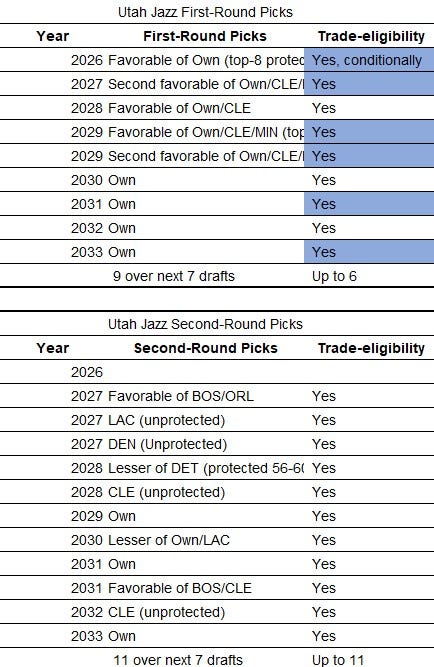
The Jazz are down to one extra first-round pick in 2029 and control the rest of their own picks. They could be open to trading them, but not necessarily for players. Most of their picks through the end of the decade are owed by, or have swap rights with, the Cavaliers and Timberwolves, both of whom are expected to be good. They could seek to swap those for potentially more valuable selections, like when they traded three lower-value first-round picks for a potentially valuable Suns 2031 first-round pick.
They also now have 11 first-round picks at their disposal. They previously didn’t have many second-round picks, but they’ve loaded up on them over the past year. Those are more likely to be used in trades for upgrades to the bench.
