

Understanding the Warriors Complicated Summer Ahead - 2026 Offseason Preview
On the Warriors' upcoming offseason, their salary cap and draft pick situation, notable players with impending contract situations, and how 2027 cap space could influence their decisions.

We are deep into the late stages of the Warriors’ dynasty, and it has been a roller coaster, to say the least. They’ve had one of the more volatile stretches in recent memory, going from missing the playoffs to winning a championship, then either missing the playoffs again or falling short of the Conference Finals. Stephen Curry, Draymond Green, and Steve Kerr have continued to play their parts, but missed draft picks, injury luck, and general roster inconsistency have left them closer to an average team for most of this stretch.
The Warriors are entering Curry’s 18th season at a significant disadvantage in constructing a competitive roster around him. They’ve done well enough to keep the talent level respectable, including acquiring Jimmy Butler without giving up too many assets and while maintaining most of their draft capital. That matters for an aging team without a clear cornerstone in place once Curry is gone.
But with Butler’s injury and the uncertainty around what type of player he will be when he returns, the Warriors are back in a similar position to where they were before acquiring him, if not worse.
There are all sorts of uncertainties surrounding the Warriors’ roster, and beyond the roster, Kerr’s future. But as long as Curry is bought in, a full-scale rebuild will remain on the back burner. They’ll continue to walk the line between fielding a competitive roster around him and avoiding a deep push into their asset base.
2026 Offseason Previews

Atlanta Hawks | Boston Celtics | Brooklyn Nets | Charlotte Hornets | Chicago Bulls | Cleveland Cavaliers | Dallas Mavericks | Denver Nuggets | Detroit Pistans | Golden State Warriors | Houston Rockets | Indiana Pacers | Los Angeles Clippers | Los Angeles Lakers | Memphis Grizzlies |
2026 Contract Projections
Current Extension Eligible Players Part 1 | Current Extension Eligible Players Part 2 | Current Extension Eligible Players Part 3 | Current Extension Eligible Players Part 4 | Standout Minimum Players | Free Agents and Pending Options Part 1 | Free Agents and Pending Options Part 2
Salary cap situation
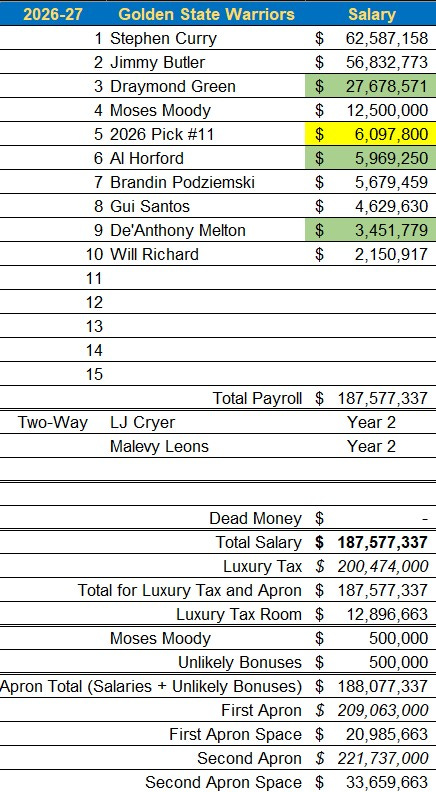
The Warriors are entering the 2026 offseason with a fluid salary-cap situation. There is a strong chance we already know which route they will take. They have ten players rostered and a high payroll, giving them just $13 million below the luxury tax line, including their lottery pick, projected to be 11th overall in the 2026 draft. That threshold is not as important since they will exceed it anyway.
The more important decision is whether the Warriors operate below the $209.4 million first apron or between the first and second aprons. They are projected to be $21 million below the first apron. Teams below that threshold have access to the $15.1 million non-taxpayer mid-level exception and the $5.5 million bi-annual exception. They can also sign-and-trade for free agents and use the expanded trade exceptions that allow teams to take on more salary in a trade than they send out.
The Warriors may prefer to operate above that threshold. The only way they could reasonably operate as a below-first-apron team is by shedding significant payroll, such as trading Butler’s $56 million salary. The $21 million cushion below the first apron would not be enough to re-sign Porzingis while also filling five more roster spots. Because of that, it’s highly unlikely they’ll use any of the mechanisms listed above, including a sign-and-trade for a free agent.
This is important because it makes it highly unlikely the Warriors can sign LeBron James, whom they are reportedly interested in. Even if James were to take roughly half his current salary, around $25 million to $26 million, the Warriors could not fill out the roster unless Butler or Green were also heading out. There are too many obstacles for that path to be worth it.
The most likely way the Warriors sign a free agent is through the veteran minimum and the taxpayer mid-level exception (T-MLE). The latter is reserved for teams above the first apron and below the second apron. In all likelihood, the Warriors will operate in that range, above the first apron and below the second apron, just like they did this past season.
They could still make a big trade for an All-Star within those thresholds, but they would be unable to use expanded trade exceptions. They would need to send out 100 percent or more of the salaries they’re taking in. They’ll likely be unable to exceed the $221.7 million second apron since aggregating multiple salaries in a trade or using the T-MLE are second apron hard cap triggers.
The difference between the two aprons is roughly $12.6 million. That is a significant amount of money that would allow the Warriors to field a deeper roster. They are more likely to retain a strong starting five and quality reserves by operating above the first apron.
It’s worth noting that these projections factor in the player options of Draymond Green, Al Horford, and De’Anthony Melton. Melton seems like a lock to decline his minimum option, while Green and Horford are more likely to pick theirs up. If they do, the apron projections mentioned earlier are still relatively accurate.
If the Warriors don’t make major changes, they could have Green and Horford back around their player-option amounts, fill out the back end of the roster with minimum signings, including Pat Spencer and Quentin Post, and use their T-MLE. This would leave them with enough room below the second apron to re-sign Porzingis to a starting salary in the $21 million to $24 million range, depending on whether they want to keep a roster spot open during the season.
