

The Heat's Guide to Trading for a Star - 2026 Offseason Preview
On the Heat upcoming offseason, their salary cap and draft pick situation, notable players with impending contract situations, and their viability to trade for a star.

The Miami Heat are one year removed from trading Jimmy Butler. The return did not get a massive haul of draft capital, a blue-chip young centerpiece, or a veteran who clearly raised their ceiling. Still, they have tried to balance remaining as competitive as possible while leaning more heavily on internal development, and they have managed to straddle both timelines better than expected.
Now the Heat enter the 2026 offseason after missing the playoffs for the first time since 2019. That is obviously a disappointing outcome by their standards, but the season was not without encouraging signs. Bam Adebayo continued to grow offensively, which matters as his max extension kicks in. Around him, they’ve built a deep roster of useful players.
Overall, this was not a lost season. The developments of Davion Mitchell, Jaime Jaquez Jr., Pelle Larsson, and Kasparas Jakucionis are among the younger or lower-cost players who gave the team real developmental progress to point to. But it did make something clearer: the Heat still need another star, and ideally a new best player, if they are going to put the rest of this roster in its proper place.
Contract Projection Series: Current Extension Eligible Players Part 1 | Current Extension Eligible Players Part 2 | Current Extension Eligible Players Part 3 | Current Extension Eligible Players Part 4 | Standout Minimum Players | Free Agents and Pending Options Part 1 | Free Agents and Pending Options Part 2 | Restricted Free Agents | Future Veteran Extensions Part 1 | Future Veteran Extensions Part 2 | Rookie-Scale Extensions Part 2
Finances and assets
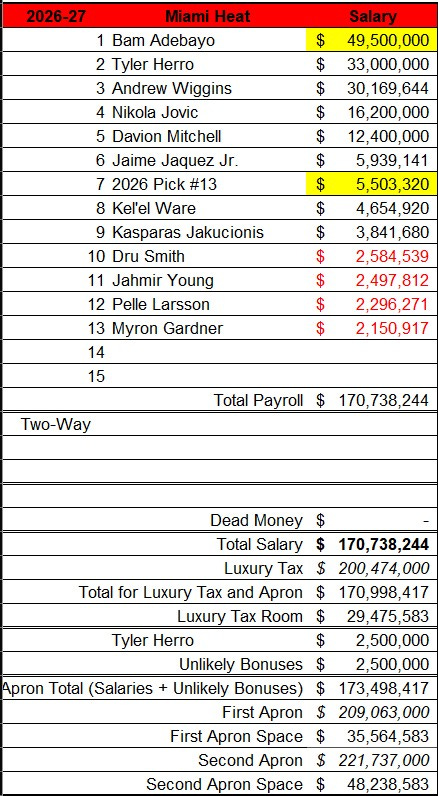
Last year, the Heat looked like a plausible 2026 cap space team. That is no longer the case after re-signing Mitchell and extending Nikola Jovic. They will still enter the 2026 offseason with meaningful flexibility, but operating as an over-the-cap team. They are projected to be $29.5 million below the $200.5 million luxury tax line and $35.5 million below the $209 million first apron.
This projection assumes Andrew Wiggins picks up his $30 million player option, which still seems like the most likely outcome. If he were to decline it, the Heat could explore bringing him back on a restructured deal with more years and a lower annual salary. But that does not feel especially likely right now, despite how important he has been for them.
The Heat still clearly wants to preserve flexibility from year to year. Even though the Heat won’t operate with cap space this summer, they could still position themselves to have a much cleaner path to meaningful cap room in 2027. That is one way they could acquire a star if they do not land one before then.
But that would mean not extending Wiggins. They may prefer he pick up his option so he remains an expiring contract and they maintain cap flexibility. They’d still have the option to extend him at any point next season before his contract expires if they fulfill roster goals and no longer need cap flexibility.
Like a lot of teams, the Heat already have a nearly full roster. They effectively have 13 players accounted for, including a first-round pick that is currently projected to land 13th overall. There is always a small chance of a lottery jump, but it would be unprecedented to jump into the top four with 4.8 percent odds. Given the depth of the current roster, this still looks more like a team that should be thinking about consolidation than another offseason of simply adding one more young player to the mix.
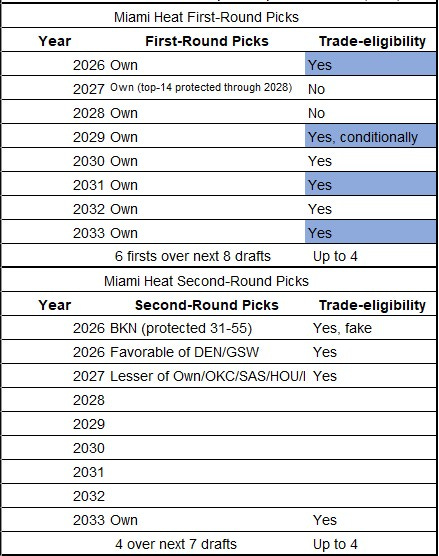
What helps the Heat more now than in previous offseasons is its improved draft-pick situation. Last year, they were limited to trading just two first-round picks because of the Stepien Rule complications stemming from the Kyle Lowry trade. This summer, they could trade up to four: 2026 (13th), 2029 (conditionally), 2031, and 2033.
The Heat can technically guarantee trading three in 2026, and either 2030 and 2032, or 2031 and 2033. Trading the 2029 requires the 2027 first-round pick owed to the Hornets, which is lottery protected in 2027 and unprotected in 2028, conveying in 2027. If it conveys in 2028, then each subsequent first-round pick gets pushed back a year. This would limit the receiving team to 2030 and 2032 first-round picks, as opposed to 2029, 2031, and 2033. The Heat could get around this by reacquiring the pick from the Hornets.
