

Weighing If the Pelicans Should Rebuild - 2026 Offseason Preview
On the Pelicans' upcoming offseason, their salary cap and draft pick situation, their means to upgrade the frontcourt, and the case for them to trade their best players for as much value as possible.

The Pelicans endured a tumultuous year after coming into it with intentions to win. They received a ton of negative publicity as early as last offseason, sparked by controversial moves by their new front office. Despite earnestly trying to win games, they lost as much as the teams losing on purpose to maximize lottery odds. This was a damaging and embarrassing result considering they traded away not one but two 2026 first-round picks that ended up in the lottery.
There were some positives to take away. They received encouraging development early on from their two rookies Derik Queen and Jeremiah Fears. They got a strong comeback from Saddiq Bey, who emerged as a starting-level player. They also saw sustained consistency and a mostly healthy season from Zion Williamson. Despite all that, their season is largely overshadowed by mismanagement and bad losses.
In all likelihood, the Pelicans will continue to build on what they currently have and make another push for the playoffs. They have the cap flexibility to run it back with this core and the means to add to it. They may believe some roster modifications, particularly upgrading the frontcourt, could get them back into playoff contention with good health provided.
But after seeing this group together for roughly five years, it might be fair to wonder if their overall ceiling is the occasional playoff appearance. It may be worth weighing the benefits of trading their best veterans, extracting as much positive value as possible, and entering a rebuild where they can fully focus on developing their youth.
Contract Projection Series: Current Extension Eligible Players Part 1 | Current Extension Eligible Players Part 2 | Current Extension Eligible Players Part 3 | Current Extension Eligible Players Part 4 | Standout Minimum Players | Free Agents and Pending Options Part 1 | Free Agents and Pending Options Part 2 | Restricted Free Agents | Future Veteran Extensions Part 1 | Future Veteran Extensions Part 2 | Rookie-Scale Extensions Part 2
2026 Offseason Previews

Atlanta Hawks | Boston Celtics | Brooklyn Nets | Charlotte Hornets | Chicago Bulls | Cleveland Cavaliers | Dallas Mavericks | Denver Nuggets | Detroit Pistans | Golden State Warriors | Houston Rockets | Indiana Pacers | Los Angeles Clippers | Los Angeles Lakers | Memphis Grizzlies |
Finances and assets
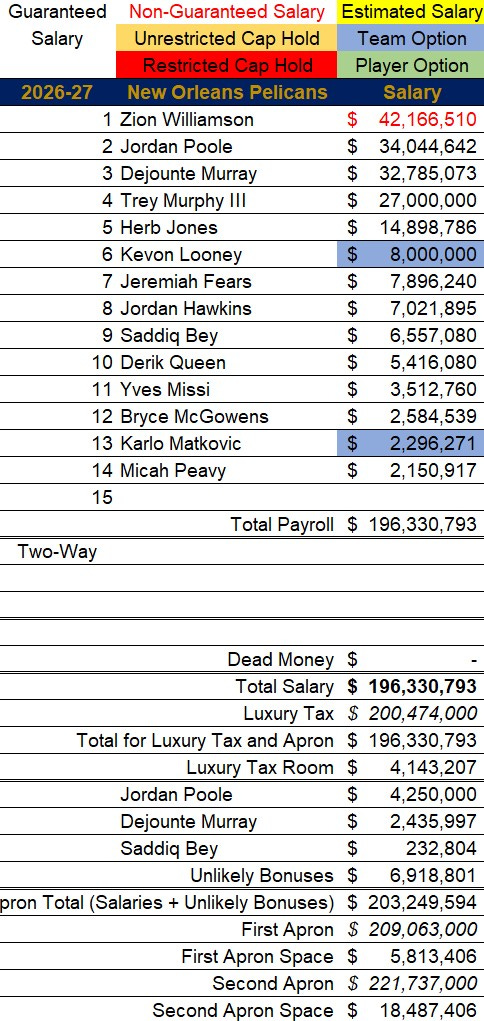
The Pelicans are heading into the 2026 offseason as an over-the-cap team. There was an unlikely path to cap space, but it would have required waiving Williamson, whose contract is not fully guaranteed. He now has at least 80 percent of his $42.2 million salary guaranteed as a result of playing 61 games this season. He can get the final 20 percent guaranteed by meeting weigh-ins, but at this point, there is no reason for the Pelicans to waive him. It doesn’t make sense to carry $33.7 million in dead money on their books not to play him.
As an over-the-cap team, the Pelicans will have access to the $15 million mid-level exception, $5.5 million biannual exception, and two trade exceptions worth $13.4 million and $4.5 million. They can also use expanded trade exceptions that allow them to take back more salary than they send out.
Using any of these exceptions will hard cap the Pelicans at the $209.1 million first apron, but they won’t exceed that threshold or the luxury tax line. They and the Hornets remain the only two teams in NBA history to have never paid the luxury tax, and they should continue that streak into a 24th consecutive year after the abysmal season they just had.
However, the Pelicans currently project to be just $4.1 million below the $200.5 million luxury tax line with 14 players rostered. They’ll have a couple of decisions to make with that self-imposed hard cap in mind. They involve the pending team options for Kevon Looney ($8 million) and Karlo Matkovic ($2.3 million). There’s no reason not to hold onto Matkovic’s salary as a useful, high-energy fifth big who is making less than the veteran minimum next season.
However, Looney will almost certainly get his option declined after failing to carve out a role in a rotation that was desperate for center play. Declining his $8 million salary would leave the Pelicans $12.1 million below the luxury tax line, while needing to fill only one more roster spot to get to the 14-player minimum roster requirement. Unlike players on non-guaranteed contracts, options must be exercised or declined before the start of free agency.
That would leave the Pelicans with plenty of flexibility to use most of the $15 million non-taxpayer mid-level exception or make a trade that significantly increases their payroll. They could also look to trade a player out of the rotation, such as Jordan Hawkins ($7 million), to create more flexibility to use both the MLE and an expanded trade exception.
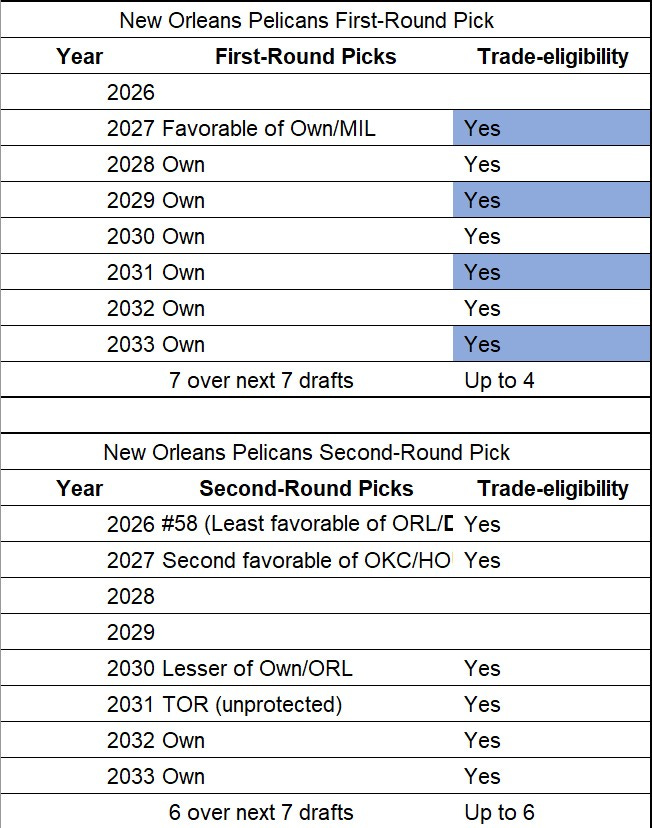
While the Pelicans do not have a first-round pick in this year’s draft, they have all of their own first-round picks through 2033, including the more favorable of their own and the Bucks’ first-round pick in 2027. They can trade a maximum of four first-round picks this offseason: 2027, 2029, 2031, and 2033. They also have six second-round picks, including the 58th overall pick in the 2026 draft. If they keep it, that player will likely occupy a two-way spot instead of a standard roster spot.
